

Job Offer Assessment: 9 Essential Steps for Simple Decisions
Master job offer assessment with 9 essential steps. Evaluate compensation, culture, and growth opportunities for informed career decisions in 2026.
 Emily Johnson
Introduction

Key Takeaways
- Job offer assessment requires evaluating multiple factors beyond salary, including culture, growth opportunities, and work-life balance
- A holistic approach to career decisions helps ensure alignment with personal values and long-term goals
- Understanding technological infrastructure and ATS compatibility is increasingly important in 2026's job market
- Strategic evaluation prevents accepting positions that look impressive on paper but fail to deliver satisfaction
- Creating a structured assessment framework leads to more informed and confident career choices
Reflecting on my career journey, I recall a pivotal moment in 2010 when I received an enticing job offer from a prestigious company. The position promised a lucrative salary and impressive title, yet something didn't sit right. Back then, I focused solely on the immediate benefits, overlooking factors like company culture, growth opportunities, and work-life balance.
That experience taught me a valuable lesson that remains crucial in 2026: assessing a job offer requires looking beyond the surface level. The excitement of a new opportunity can cloud judgment, making it easy to overlook warning signs or misalignments with your career trajectory.
Today's job market presents additional layers of complexity. Technological advancements have transformed how companies evaluate candidates and how professionals should evaluate employers. Understanding how a company's technological infrastructure aligns with your skills and future ambitions can significantly impact your career satisfaction and growth potential.
The stakes are higher than ever. With remote work options, evolving workplace cultures, and rapidly changing industry landscapes, making the wrong choice can set your career back years. Conversely, a well-evaluated decision can accelerate your professional growth and personal fulfillment.
This guide walks you through nine essential steps for conducting a thorough job offer assessment. You'll learn to evaluate compensation packages comprehensively, assess cultural fit, identify growth opportunities, and recognize red flags before they become career obstacles. Whether you're considering your first professional role or contemplating a senior-level transition, these strategies will help you make strategic career decisions that align with where you want to go, not just where you are.
By the end of this article, you'll have a practical framework for evaluating any job offer with confidence, ensuring your next career move is both strategically sound and personally rewarding.
Job Offer Assessment: 9 Simple Steps For Smart Decisions
Master job offer assessment with 9 simple steps. Evaluate compensation, culture, and growth for informed career decisions in 2026.
The Components of Total Compensation
A comprehensive compensation package extends far beyond your annual salary. Start by identifying all monetary and non-monetary benefits included in your offer. Base salary forms the foundation, but bonuses, commissions, and performance incentives can substantially increase your total earnings.
Equity compensation—whether stock options, restricted stock units, or profit sharing—represents potential future value. Consider vesting schedules, company valuation trends, and liquidity timelines when evaluating equity offers. These components can transform a modest base salary into a lucrative long-term opportunity.
Retirement contributions deserve careful attention in your job offer assessment. Employer 401(k) matching, pension plans, and contribution percentages directly impact your financial future. A company offering a generous match effectively increases your compensation by thousands of dollars annually.
Health Benefits and Insurance Coverage
Health insurance represents one of the most valuable yet often underestimated compensation components. Compare premium costs, deductibles, co-pays, and coverage networks across offers. A plan with lower premiums but high deductibles may cost more in practice than one with higher premiums and comprehensive coverage.
Additional insurance benefits—dental, vision, life, and disability coverage—add measurable value to your total package. Calculate the cost of purchasing these benefits independently to understand their true worth. Employer-sponsored coverage typically costs significantly less than individual market rates.
Hidden Costs and Expenses
Every job offer carries hidden costs that reduce your net compensation. Commuting expenses, parking fees, professional wardrobe requirements, and relocation costs all impact your financial bottom line. Remote or hybrid positions may offer substantial savings in these areas.
Professional development costs vary widely between employers. Some companies provide generous training budgets, conference attendance, and certification reimbursements, while others expect employees to fund their own growth. These differences can amount to thousands of dollars annually.
Creating a Numerical Comparison Framework
Develop a spreadsheet to compare offers objectively. List all compensation components with assigned dollar values for each offer. Include base salary, estimated bonuses, equity value, retirement contributions, insurance benefits, and other perks.
Subtract estimated costs—commuting, parking, healthcare out-of-pocket maximums, and professional expenses—from your total compensation figure. This calculation reveals your true net compensation, enabling apples-to-apples comparisons between seemingly different offers.
Weight components based on your priorities and life circumstances. A generous parental leave policy holds different value depending on your family planning timeline. Tuition reimbursement matters more if you're pursuing additional education.
Long-Term Financial Impact
Consider how each offer positions you financially over multiple years. A lower starting salary with aggressive merit increase potential may surpass a higher initial offer with minimal growth. Review historical raise percentages and promotion timelines when available.
Retirement contributions compound over time, making early-career retirement benefits particularly valuable. A company contributing an additional two percent to your 401(k) can translate to tens of thousands of dollars in retirement savings over a decade.
Beyond the Numbers
While numerical analysis forms the foundation of job offer assessment, remember that some compensation elements resist quantification. Flexible scheduling, unlimited paid time off, and wellness programs contribute to overall life satisfaction and work-life balance. Assign estimated values to these benefits based on their personal importance to you.
The most financially attractive package isn't always the best choice. Balance compensation analysis with considerations of career growth, company culture, and alignment with your professional goals. A complete job offer assessment integrates financial factors with strategic career planning.
Company Culture and Values: Ensuring Long-Term Fit

Company culture isn't just a buzzword—it's the daily reality that shapes your work experience, job satisfaction, and career longevity. A mismatch between your values and your employer's culture can lead to burnout, disengagement, and early departure, regardless of how attractive the compensation package appears.
When conducting your job offer assessment, evaluating cultural fit requires active investigation rather than passive acceptance of marketing materials. The effort you invest in understanding a company's true culture will pay dividends in long-term career satisfaction.
Observing Culture During the Interview Process
Your interview experience provides valuable clues about company culture. Pay attention to how interviewers interact with each other and with you. Do they seem genuinely engaged and collaborative, or rushed and disconnected?
Notice the office environment if you visit in person. Is the workspace collaborative or compartmentalized? Are employees interacting positively, or does the atmosphere feel tense? These observations offer authentic insights that polished company websites rarely reveal.
The interview process itself speaks volumes. A disorganized, disrespectful, or opaque process often reflects broader organizational dysfunction. Conversely, a structured, communicative process that respects your time typically indicates a well-managed company.
Leveraging Employee Reviews and External Research
Employee review platforms provide unfiltered perspectives from current and former team members. Look for patterns rather than isolated complaints—recurring themes about leadership, work-life balance, or advancement opportunities deserve serious consideration.
Balance negative reviews with positive ones, and pay special attention to how the company responds to criticism. Organizations that engage constructively with feedback demonstrate transparency and accountability.
Research the company's public presence, including social media, press coverage, and industry reputation. This broader context helps you understand how the organization operates beyond its internal walls.
Assessing Leadership Transparency and Communication
Leadership style profoundly impacts daily work life. During your evaluation, ask about communication cadence, decision-making processes, and how information flows through the organization.
Transparent leaders share company performance, strategic direction, and challenges openly with their teams. Ask interviewers how leadership communicates during difficult times—their answers will reveal whether the company prioritizes honesty or obscures uncomfortable truths.
Inquire about accessibility to senior leadership. Can employees voice concerns directly, or must feedback travel through multiple layers? Organizations with open-door policies typically foster healthier, more engaged workforces.
Aligning Personal Values with Organizational Values
Identify your non-negotiable professional values before evaluating any offer. Do you prioritize innovation, stability, social impact, diversity, or autonomy? Understanding your priorities creates a clear framework for assessment.
Research the company's stated values and look for evidence they're practiced, not just posted. Ask specific questions: "Can you share an example of how the company demonstrated [stated value] recently?" Concrete examples reveal authentic commitment.
Consider how the company approaches work-life integration, professional development, and employee well-being. These practices reflect deeper organizational values that impact your daily experience and long-term satisfaction.
Connecting Culture to Retention and Career Success
Cultural alignment directly correlates with job satisfaction and retention. When your values align with your employer's, you're more likely to feel engaged, motivated, and committed to organizational success.
A positive cultural fit enhances collaboration, reduces workplace stress, and creates opportunities for meaningful relationships with colleagues. These factors contribute significantly to career fulfillment beyond any compensation package.
Conversely, cultural misalignment leads to chronic dissatisfaction, reduced performance, and eventual departure—often within the first year. Investing time in cultural assessment during your job offer evaluation protects against costly career missteps and positions you for sustainable success.## Career Growth and Advancement Opportunities
When conducting your job offer assessment, evaluating career growth potential is just as critical as analyzing compensation. A position that offers limited advancement opportunities can leave you feeling stagnant within months, regardless of how attractive the initial salary appears.
Career growth encompasses more than just vertical promotions. It includes skill development, lateral movement opportunities, mentorship access, and the company's investment in employee development. Understanding these factors helps you determine whether this role will serve as a stepping stone or a dead end in your professional journey.
Understanding Promotion Pathways and Timelines
During your job offer assessment, ask specific questions about promotion timelines and criteria. Request clarity on what advancement looks like from your potential role—whether it's a defined pathway or case-by-case evaluation.
Inquire about the typical tenure required before promotion consideration. Some organizations have structured advancement schedules, while others operate on merit-based systems without clear timelines. Understanding this structure helps you set realistic expectations and evaluate whether the pace aligns with your career ambitions.
Ask to speak with someone who has been promoted from the role you're considering. Their experience provides invaluable insight into whether the company follows through on growth promises or if advancement remains theoretical.
Evaluating Skill Development Programs
Professional development opportunities directly impact your long-term career trajectory. During negotiations, ask about:
- Training budgets allocated per employee annually
- Access to conferences, workshops, or industry events
- Tuition reimbursement or continuing education support
- Internal training programs and certification opportunities
- Cross-functional project participation
Companies that invest in employee development demonstrate commitment to long-term growth. A robust learning culture indicates that the organization values skill enhancement and career progression.
Consider how the role itself will expand your capabilities. Will you gain exposure to new technologies, methodologies, or leadership responsibilities? The inherent learning curve of the position matters as much as formal training programs.
Assessing Mentorship and Internal Mobility
Mentorship availability can significantly accelerate your professional growth. Ask whether the company offers formal mentorship programs or if mentoring relationships develop organically.
Inquire about the backgrounds of leadership team members. Organizations that promote from within typically demonstrate stronger commitment to employee development than those that consistently hire externally for senior roles.
Internal mobility deserves careful consideration in your job offer assessment. Ask about:
- Policies regarding internal transfers or role changes
- Whether employees can explore opportunities in different departments
- How long you must remain in your initial role before considering internal moves
- Success stories of employees who have transitioned between teams
Companies with high internal mobility rates often foster more dynamic career paths and retain talent more effectively.
Critical Questions to Ask During Negotiations
Framing growth-focused questions during negotiations demonstrates strategic thinking and long-term commitment. Consider asking:
- "What does success look like in this role after six months, one year, and three years?"
- "Can you describe the career trajectory of someone who previously held this position?"
- "What percentage of leadership positions are filled through internal promotions versus external hires?"
- "How does the company support employees who want to develop new skills outside their immediate job responsibilities?"
- "What opportunities exist for cross-departmental collaboration or project work?"
These questions reveal whether the organization has thoughtful growth frameworks or operates reactively. Pay attention to the specificity of responses—vague answers often indicate limited structure or investment in development.
Connecting Growth Potential to Long-Term Career Goals
Your job offer assessment should weigh how this opportunity advances your broader career objectives. A role that offers rapid skill acquisition in your first two years might outweigh one with a higher starting salary but limited learning opportunities.
Consider the transferability of skills you'll develop. Will this experience position you competitively for future roles, either within the company or externally? Evaluate whether the growth trajectory aligns with where you want to be in five to ten years.
Remember that career advancement isn't always linear. Sometimes lateral moves that broaden your expertise create more valuable long-term opportunities than immediate vertical promotions. Your assessment should reflect your personal definition of career progression and success.## Work-Life Balance and Flexibility in 2026
Work-life balance has evolved from a nice-to-have perk to a critical factor in job offer assessment. In 2026, professionals increasingly prioritize roles that support their personal well-being alongside career ambitions. When evaluating a job offer, understanding the company's approach to flexibility, remote work, and boundaries can significantly impact your long-term satisfaction and performance.
The modern workplace has shifted dramatically, with hybrid and remote models becoming standard rather than exceptional. During your job offer assessment, it's essential to clarify exactly what flexibility means at this particular organization—policies vary widely, and assumptions can lead to misalignment.
Remote Work and Hybrid Policies
Start by asking specific questions about the company's remote work philosophy. Is remote work a permanent option, or is it subject to change based on leadership preferences? How many days per week are employees expected in the office for hybrid roles?
Request clarity on the following:
- Location flexibility: Can you work from anywhere, or are there geographic restrictions?
- Equipment and support: Does the company provide home office equipment, internet stipends, or coworking space memberships?
- Communication expectations: What are the core collaboration hours? Are there requirements for video-on meetings?
- Performance measurement: How does the company evaluate remote workers to ensure fairness with in-office colleagues?
Understand whether flexibility is truly embedded in the culture or simply a policy on paper. Ask to speak with team members who currently work remotely to gauge their authentic experience.
Flexible Scheduling Options
Beyond location flexibility, time flexibility matters. Some organizations offer compressed workweeks, flexible start and end times, or asynchronous work arrangements that allow employees to manage their schedules around personal commitments.
During negotiations, explore:
- Core hours: Are there mandatory times when all team members must be available?
- Schedule customization: Can you adjust your hours to accommodate personal needs like childcare, education, or caregiving?
- Part-time or reduced-hour options: Does the company support alternative arrangements for different life stages?
Flexible scheduling demonstrates trust and acknowledges that productivity isn't confined to traditional 9-to-5 hours. Companies that embrace this philosophy often see higher engagement and retention.
Paid Time Off and Leave Policies
PTO policies reveal much about an organization's values. When conducting your job offer assessment, examine not just the quantity of time off, but the quality of the policy and the cultural attitude toward taking it.
Key areas to investigate:
- Vacation days: How many days are provided annually? Does the allotment increase with tenure?
- Sick leave: Is sick time separate from vacation, or is it a combined PTO bank?
- Parental leave: What is offered for maternity, paternity, and adoption leave? Is it paid or unpaid?
- Sabbaticals: Does the company offer extended leave options for long-tenured employees?
- Unlimited PTO: If offered, what is the actual average usage? Unlimited policies can sometimes result in employees taking less time off due to unclear expectations.
Ask about the approval process and blackout periods. In some organizations, taking time off requires extensive planning and justification, which can undermine the benefit.
Setting Boundaries and Preventing Burnout
A job offer may look attractive on paper, but if the role demands constant availability or regularly extends beyond reasonable hours, work-life balance quickly deteriorates. Assess the company's approach to boundaries and burnout prevention.
Questions to ask:
- After-hours expectations: Is there an expectation to respond to emails or messages outside business hours?
- Workload management: How does the team handle capacity planning to prevent overload?
- Mental health support: Does the company offer employee assistance programs, mental health days, or wellness resources?
- Vacation coverage: Is there a system to ensure work is covered when team members are away, or do employees return to overwhelming backlogs?
Observe the interview process itself for clues. If recruiters or hiring managers send emails late at night or on weekends, or if they're difficult to schedule with during business hours, these may be indicators of the company's work culture.
Evaluating 2026 Workplace Expectations
In 2026, top talent expects employers to prioritize holistic well-being. Organizations that fail to adapt risk losing competitive advantage in recruitment and retention. As you assess your job offer, consider whether the company's policies align with contemporary workplace standards.
Progressive organizations are implementing:
- Four-day workweeks or summer Fridays
- Meeting-free days to allow for deep work
- Mandatory minimum vacation requirements to encourage rest
- Wellness stipends for fitness, therapy, or personal development
- Clear right-to-disconnect policies
These initiatives signal that leadership understands sustainable performance requires genuine rest and recovery. Companies investing in these areas tend to foster healthier, more productive teams.
Assessing Cultural Attitudes Toward Balance
Policies matter, but culture determines whether those policies are truly accessible. During your job offer assessment, look for evidence that work-life balance is practiced, not just promoted.
Seek insights by:
- Talking to current employees: Ask about their typical workday, when they usually log off, and whether they feel comfortable using PTO
- Reviewing leadership behavior: Do executives model healthy boundaries, or do they send messages at all hours?
- Checking company reviews: Platforms like Glassdoor often reveal whether balance claims match employee experiences
- Observing team dynamics: During interviews, do team members seem energized or exhausted?
Red flags include high turnover rates, frequent mentions of "wearing multiple hats," or vague answers about workload expectations. Trust your instincts—if something feels off during the interview process, it's worth investigating further.
Making Balance a Non-Negotiable
As you move through your job offer assessment, remember that work-life balance directly impacts your health, relationships, and career longevity. A role that demands unsustainable hours or constant availability may offer short-term financial gains but can lead to burnout and diminished quality of life.
Prioritize organizations that demonstrate genuine commitment to employee well-being through both policy and practice. The right opportunity will support your professional growth while respecting your personal life—because sustainable success requires both.## Technology Infrastructure and ATS Compatibility
When evaluating a job offer, most candidates focus on salary and benefits while overlooking a critical factor: the company's technology infrastructure. The tools, systems, and digital platforms an organization uses directly impact your daily workflow, professional development, and long-term career trajectory.
As someone who has spent years analyzing how Applicant Tracking Systems filter candidates, I've learned that a company's approach to technology reveals much about its operational maturity and commitment to employee success. Understanding the employer's tech stack during your job offer assessment helps you gauge whether you'll have the resources needed to perform effectively and grow professionally.
Evaluating Digital Tools and Platforms
Start by asking specific questions about the technology you'll use daily. What project management tools does the team rely on? Which communication platforms are standard? What software will you need to master to succeed in the role?
Companies investing in modern, industry-standard tools typically demonstrate a commitment to efficiency and employee productivity. Conversely, organizations relying heavily on outdated systems may signal budget constraints, resistance to change, or limited technical leadership.
Consider how the technology aligns with your existing skills and career goals. If you're building expertise in specific platforms or methodologies, ensure the new role provides opportunities to deepen that knowledge rather than requiring you to work with legacy systems that may limit your marketability.
Understanding ATS and Recruitment Technology
The sophistication of a company's Applicant Tracking System offers insights into their hiring maturity and organizational processes. Companies using advanced ATS platforms often have more structured onboarding, better documentation, and clearer career progression frameworks.
During your conversations, inquire about how the company manages talent acquisition and internal mobility. Do they use their ATS for performance tracking and succession planning? Can employees apply for internal positions through a transparent system? These details reveal whether the organization has invested in infrastructure that supports career development.
For tech roles specifically, understanding ATS compatibility becomes even more important. Companies that optimize their hiring technology typically maintain similar standards across their operational systems, creating environments where technical professionals can thrive.
Assessing Technology Training and Support
Beyond the tools themselves, evaluate the support structure surrounding technology adoption. Does the company provide comprehensive training for new platforms? Is there dedicated IT support when technical issues arise? Are employees encouraged to pursue certifications or professional development in relevant technologies?
Organizations with robust technology training programs demonstrate they value continuous learning and understand that tools are only effective when people know how to use them properly. This commitment often extends beyond technology to broader professional development initiatives.
Ask about the onboarding process for technical systems. A well-structured technology onboarding program suggests the company has thoughtfully designed employee experiences and invested in retention strategies.
Technology Infrastructure as a Career Catalyst
The right technology infrastructure can accelerate your career by exposing you to industry-standard tools, automating routine tasks, and enabling you to focus on high-value work. Conversely, inadequate technology can create frustration, limit your productivity, and slow your professional growth.
Consider whether the company's technology choices align with industry trends and future demands. Working with cutting-edge platforms positions you for advancement, while experience with obsolete systems may make future job searches more challenging.
For those in technical fields, the employer's tech stack becomes part of your professional portfolio. Each tool you master, each system you optimize, and each platform you implement adds to your marketability and expertise.
Questions to Ask During Job Offer Assessment
Before accepting an offer, gather specific information about technology infrastructure:
- What core platforms and tools does the team use daily?
- How often does the company update or upgrade its technology systems?
- What is the process for requesting new tools or software?
- Does the company provide technology stipends or equipment allowances?
- How does the organization handle cybersecurity and data protection?
- What collaboration tools support remote or hybrid work arrangements?
These questions demonstrate your strategic thinking while providing concrete information for your decision-making process. The quality and transparency of the responses often reveal as much as the answers themselves.
Technology infrastructure assessment isn't about finding the company with the flashiest tools. It's about ensuring the organization provides the digital foundation you need to perform effectively, develop professionally, and advance your career goals. This evaluation becomes an essential component of comprehensive job offer assessment in 2026's technology-driven workplace.## Creating Your Job Offer Assessment Framework
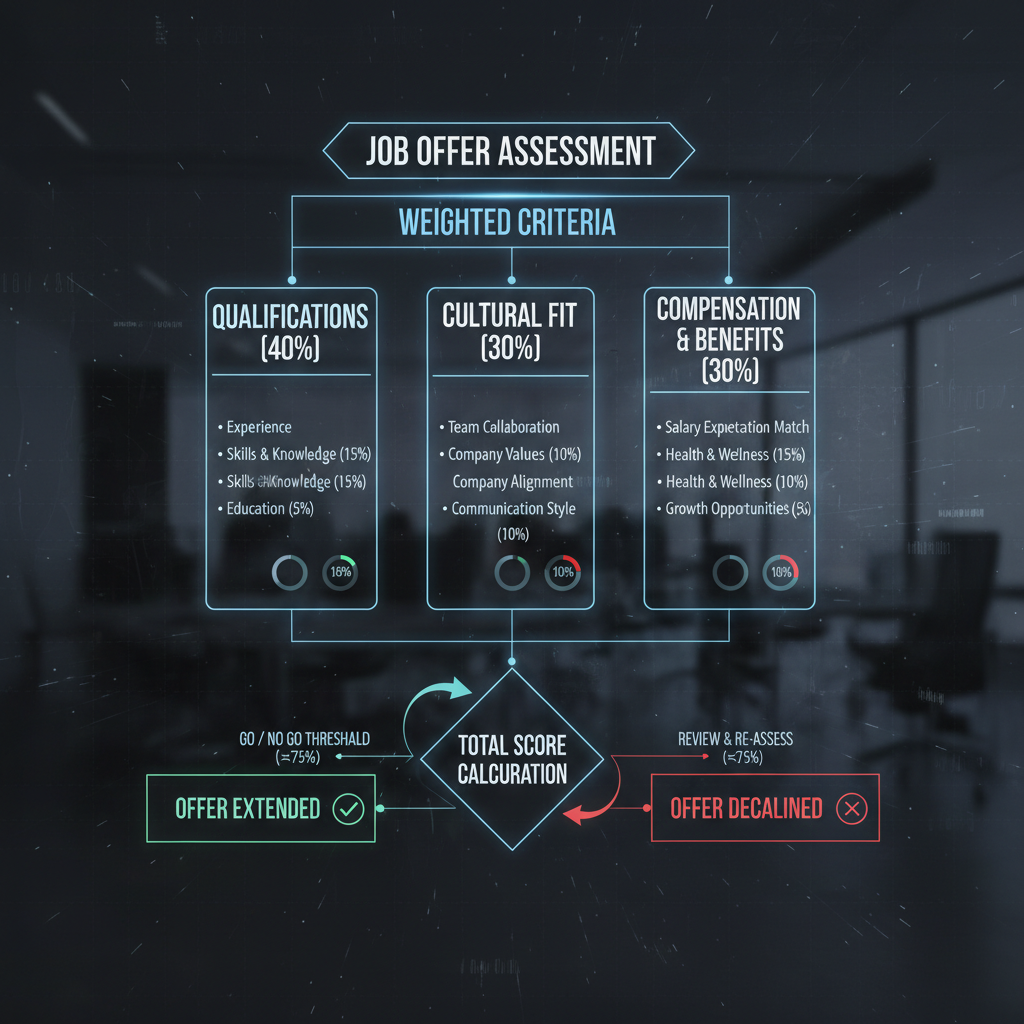
A structured job offer assessment framework transforms overwhelming decisions into clear, objective evaluations. Rather than relying on gut feelings alone, creating a systematic approach helps you weigh competing factors and make choices aligned with your career trajectory.
The most effective frameworks combine quantitative scoring with qualitative reflection. This dual approach ensures you consider both measurable elements like compensation and intangible factors like cultural fit.
The Weighted Criteria Method
Start by identifying your top evaluation categories. Common areas include compensation, career growth, work-life balance, company culture, location, and benefits. Assign each category a weight based on personal importance, ensuring all weights total 100%.
For example, if career growth matters most to you, assign it 30%. If work-life balance is equally critical, give it 30%. Distribute remaining percentages across other factors like compensation (20%), culture (15%), and benefits (5%).
Next, score each job offer on a scale of 1-10 for every category. Multiply each score by its weight, then sum the results. This produces a weighted total score that reflects your priorities rather than treating all factors equally.
Building Your Decision Matrix
Create a simple comparison table with job offers as columns and evaluation criteria as rows. This visual layout makes it easy to spot strengths and weaknesses across opportunities.
Include both objective data (salary figures, vacation days, commute time) and subjective assessments (team dynamics, manager compatibility, mission alignment). Color-code cells to highlight areas where offers excel or fall short.
Consider adding a "deal-breaker" row to identify non-negotiable requirements. If an offer fails to meet these baseline standards, no amount of scoring in other areas can compensate.
Incorporating Long-Term Career Goals
Your framework should extend beyond immediate satisfaction to evaluate strategic career positioning. Ask how each offer advances your three-year and five-year professional objectives.
Assess skill development opportunities, industry positioning, and network expansion potential. An offer with slightly lower compensation but significantly better learning opportunities may score higher when weighted for long-term growth.
Document your reasoning for each score. This written record helps you articulate your decision to others and provides a reference point if you face similar choices in the future.
Testing Your Framework
Before finalizing decisions, run sensitivity analyses. Adjust category weights to see how scores shift. If small weight changes dramatically alter rankings, you may need to refine your priorities or gather more information.
Share your framework with trusted mentors or advisors. Their external perspective can reveal blind spots or help you recalibrate weights that don't truly reflect your values.
Remember that frameworks support decision-making but don't replace judgment. If your systematic evaluation conflicts with strong intuition, explore that disconnect before proceeding. The best decisions integrate both analytical rigor and self-awareness.## Red Flags and Warning Signs to Watch For
Even the most attractive job offer can hide serious problems beneath the surface. Learning to recognize warning signs during the evaluation process protects you from costly career mistakes and ensures you make decisions aligned with your long-term goals.
High Turnover and Revolving Door Patterns
Frequent staff changes signal deeper organizational issues. When you notice multiple people have held the same position in a short timeframe, or when your interview panel includes several new hires, investigate further. Ask directly about turnover rates and average tenure in the role.
Pay attention to how the hiring manager responds to these questions. Defensive reactions or vague explanations often indicate cultural problems or unrealistic expectations that drive employees away.
Vague or Evasive Answers During Interviews
Clarity matters when evaluating any opportunity. If interviewers cannot articulate clear job responsibilities, performance metrics, or reporting structures, the organization likely lacks direction. This ambiguity creates frustration and sets you up for misaligned expectations.
Watch for evasiveness around compensation details, benefits enrollment timelines, or company financial health. Legitimate employers provide transparent information about these fundamental aspects of employment.
Pressure Tactics and Artificial Urgency
Employers who rush your decision-making process often have something to hide. Phrases like "we need an answer by tomorrow" or "other candidates are waiting" create artificial pressure designed to prevent thorough evaluation.
Respectable organizations understand that accepting a job offer represents a significant life decision. They allow reasonable time for consideration and welcome thoughtful questions throughout the process.
Unrealistic Expectations and Role Inflation
Be cautious when job descriptions require expertise across too many unrelated areas or promise rapid advancement without clear pathways. These inflated expectations often lead to burnout and disappointment.
Compare the stated responsibilities with the offered compensation and support resources. Significant mismatches suggest the employer undervalues the role or lacks understanding of what success requires.
Poor Communication and Disorganization
The hiring process reveals how an organization operates daily. Missed interview appointments, delayed responses, or contradictory information from different team members indicate systemic communication problems.
If basic coordination fails during recruitment—when companies typically showcase their best—expect worse once you join. Professional organizations maintain consistent, respectful communication throughout the hiring journey.
Trust Your Professional Instincts
Your intuition draws from accumulated experience and pattern recognition. When something feels off, even if you cannot immediately identify the specific issue, take that signal seriously. Step back and analyze what triggered your concern.
Combine instinct with objective evaluation. Document specific observations that caused discomfort, then research whether these patterns align with known warning signs. This balanced approach prevents both overlooking genuine problems and rejecting opportunities based solely on nervousness.
Recognizing red flags requires practice and self-awareness. The investment in careful observation during job offer assessment protects your career trajectory and ensures your next move advances your professional goals rather than creating new obstacles.## Negotiation Strategies and Building Leverage
Negotiation is an interpersonal decision-making process that becomes necessary when parties cannot achieve their objectives independently. Understanding this fundamental principle transforms how you approach job offer discussions—it's not adversarial, but collaborative problem-solving.
Successful negotiation requires preparation, strategic timing, and clear communication. The process involves understanding both your needs and the employer's constraints, then finding creative solutions that benefit everyone involved.
Timing Your Negotiation
Never negotiate until you have a written offer in hand. Verbal promises lack enforceability and can disappear during formalization. Once you receive the official offer, take time to review it thoroughly before responding.
Request 24 to 48 hours to consider the offer, even if you're excited. This pause demonstrates thoughtfulness and gives you space to prepare your counteroffer strategy. Employers expect candidates to take time for such important decisions.
Avoid negotiating too early in the interview process. Discussing compensation before the employer has decided they want you significantly weakens your position. Wait until they've invested time and resources in selecting you as their top candidate.
Building Your Negotiation Leverage
Leverage comes from having alternatives and demonstrating unique value. If you're interviewing with multiple companies, each offer strengthens your position with others. You don't need to disclose specific numbers, but indicating you're considering other opportunities creates urgency.
Document your accomplishments and how they relate to the role. Specific examples of past results—revenue generated, processes improved, teams led—justify higher compensation. Frame these contributions in terms of value you'll bring to the new organization.
Research market rates thoroughly using salary surveys, industry reports, and professional networks. Knowledge of comparable positions at similar companies provides objective data to support your requests. Geographic location, company size, and industry sector all influence appropriate compensation ranges.
What's Negotiable Beyond Salary
Base salary represents just one component of your total compensation package. Many elements offer negotiation flexibility, sometimes more readily than cash compensation.
Consider negotiating:
- Sign-on bonuses: One-time payments that don't affect ongoing salary budgets
- Performance bonuses: Target percentages and achievement metrics
- Equity compensation: Stock options, RSUs, or profit-sharing arrangements
- Vacation time: Additional PTO days or flexible scheduling
- Remote work flexibility: Hybrid arrangements or full remote options
- Professional development: Training budgets, conference attendance, certification costs
- Relocation assistance: Moving expenses, temporary housing, travel costs
- Title and responsibilities: Scope of role and reporting structure
- Start date: Delayed start for current commitments or personal needs
- Review timeline: Earlier performance review for faster advancement consideration
Companies often have more flexibility with non-salary items, especially when salary ranges are constrained by internal equity or budget limitations.
Effective Counteroffer Techniques
Frame your counteroffer positively, expressing enthusiasm for the opportunity while presenting your request. Begin by thanking them for the offer and reiterating your interest in the position and company.
Use specific numbers rather than ranges. Requesting a salary between two amounts signals you'll accept the lower figure. State your desired compensation clearly, supported by research and your qualifications.
Present multiple items simultaneously rather than negotiating serially. If you ask for salary adjustment first, receive it, then request additional vacation, you appear perpetually unsatisfied. Instead, present a complete package: "I'm excited about this opportunity. Based on my research and experience, I was expecting compensation in the range of $X, along with Y vacation days and Z professional development budget."
Avoid ultimatums unless you're genuinely prepared to walk away. Statements like "I need $X or I can't accept" create win-lose dynamics that damage relationships. Instead, frame requests as questions: "Is there flexibility in the salary range?" or "What would it take to reach $X?"
The Four-Step Negotiation Process
According to negotiation frameworks, successful negotiations follow a structured process. First, prepare thoroughly by understanding your priorities, researching market standards, and identifying your walk-away point.
Second, exchange information openly. Share your perspective on fair compensation while listening to the employer's constraints and priorities. This dialogue often reveals creative solutions neither party initially considered.
Third, bargain collaboratively. Present your counteroffer with supporting rationale, then work together to find mutually acceptable terms. Be prepared to make strategic concessions on lower-priority items to gain ground on what matters most.
Fourth, close and commit. Once you reach agreement, confirm all terms in writing before accepting. Ensure the revised offer letter reflects everything discussed, including verbal promises about future reviews, bonuses, or other commitments.
Maintaining Positive Relationships
Negotiation sets the tone for your future working relationship. Approach discussions professionally, focusing on mutual benefit rather than winning. Remember that the person negotiating with you—often your future manager or HR partner—will be your colleague.
Stay respectful and appreciative throughout the process. Acknowledge when the employer makes concessions and express gratitude for their flexibility. Even if you don't receive everything requested, recognize their efforts to accommodate your needs.
Be honest about your constraints and priorities. If work-life balance matters more than maximum salary, say so. Transparency builds trust and helps employers craft offers that genuinely meet your needs within their constraints.
Never make threats or comparisons that belittle the organization. Saying "Company X offered me more" creates resentment, while "Based on market research for this role and geography, I was expecting a range of $X-Y" presents objective information.
When to Walk Away
Sometimes negotiation reveals fundamental misalignment between your needs and what the employer can offer. If the gap is too large—whether in compensation, role responsibilities, or other critical factors—walking away demonstrates self-respect and career wisdom.
Decline offers professionally, thanking them for their time and consideration. Maintain positive relationships, as industries are smaller than they appear. Today's declined offer might lead to a better opportunity with the same organization in the future.
Trust your instincts during negotiation. If the employer responds to reasonable requests with pressure tactics, defensiveness, or unwillingness to discuss terms, these behaviors signal potential cultural issues. How they treat you during negotiation previews how they'll treat you as an employee.
Preparing for Common Objections
Employers may respond to counteroffers with standard objections. Prepare responses in advance so you can address concerns confidently.
If they cite budget constraints, explore non-salary alternatives or ask about timeline for future increases. "I understand the current budget limitations. Could we revisit compensation at my six-month review based on performance?"
If they mention internal equity, acknowledge the concern while emphasizing your unique qualifications. "I appreciate the need for internal fairness. My experience in [specific area] brings immediate value in [specific way], which I believe justifies the adjustment."
If they claim the offer is final, test gently: "I understand this represents your standard offer. Given my background in [area], is there any flexibility in [specific component]?" Often "final" offers have room for adjustment when candidates present compelling rationale.
Negotiation is a normal, expected part of the hiring process. Employers anticipate counteroffers and respect candidates who advocate professionally for themselves. The skills you demonstrate during negotiation—preparation, communication, problem-solving—showcase the same capabilities that will make you valuable in the role.
Sources
- What is Negotiation? - Program on Negotiation at Harvard Law School
- 4 Steps of the Negotiation Process - Harvard Business School Online
- How to Improve Your Negotiation Skills - Stanford Online
Making Strategic Career Decisions That Align With Your Goals
Ultimately, accepting a job offer should be a strategic move that aligns with where you want to go, not just a reaction to where you are. This perspective has shaped my approach to career coaching and empowered countless professionals to make informed and fulfilling career choices.
Throughout this guide, you've explored the nine essential steps of job offer assessment—from analyzing compensation packages and company culture to evaluating growth opportunities and work-life balance. Each element contributes to a comprehensive framework that transforms decision-making from emotional reaction into strategic planning.
Your Career Decision Framework
A thorough job offer assessment requires viewing each opportunity through multiple lenses. Consider how the position serves your immediate needs while advancing your long-term career trajectory. The strongest decisions emerge when compensation, culture, growth potential, and personal values align in meaningful ways.
Reflect on the complete picture rather than isolated factors. A higher salary loses value if the role offers limited advancement or compromises work-life balance. Similarly, an exciting company culture matters less if the compensation structure doesn't support your financial goals.
Taking Action With Confidence
Armed with your assessment framework, you can approach job offers with clarity and confidence. Review your documented evaluations, weigh priorities against your career goals, and trust the systematic process you've followed. Remember that negotiation remains an option even after initial assessment—use your research to advocate for improvements that better align with your needs.
When doubt arises, return to your core career objectives. Ask whether this opportunity moves you closer to your professional vision or simply represents a lateral shift. The right decision becomes clearer when viewed through the lens of strategic career development.
Moving Forward
Job offer assessment is both an art and a science. While frameworks and checklists provide structure, your unique career goals and personal values ultimately guide the final decision. Trust your preparation, honor your priorities, and choose opportunities that genuinely advance your professional journey.
Every career decision shapes your trajectory. By approaching job offers with thorough assessment and strategic thinking, you position yourself for sustained growth and fulfillment. The time invested in evaluation today prevents regret tomorrow and builds a career aligned with your authentic aspirations.
Related reading: Resume Analysis: 9 Simple Expert Tips for Ultimate Improvement, Employer Demands: 12 Essential Skills for the Best Career

Written by
Emily Johnson
Published February 21, 2026 · 34 min read
Emily Johnson is a seasoned career strategist with over a decade of experience in recruitment and talent acquisition. With a background in human resources, she excels at helping professionals refine their job search strategies, from crafting compelling resumes to mastering interview techniques. As an expert in Applicant Tracking Systems (ATS), Emily is dedicated to guiding individuals toward their dream careers.
Want this kind of read on your résumé?
We'll tell you what's actually working, what's holding you back, and what to fix — in plain English.
Get My Job Match Score