
Job Scam History: The Ultimate Guide to Surprising Trends
Discover job scam history and explore the surprising evolution of employment fraud tactics that have targeted workers throughout the decades.
 John Cronin
Introduction
Job scams aren't new. They've existed as long as people have needed work. What started as fake help-wanted ads in newspapers has morphed into elaborate digital operations that can fool even experienced professionals. A job scam is any fraudulent scheme that uses a fake or misleading employment opportunity to steal money, personal information, or both from job seekers.
In my 25 years of talent acquisition, I've watched these scams become increasingly sophisticated. At Meta, where I sourced machine learning and AI engineers at high volume, you learn to spot the patterns fast—both in legitimate candidates and in the fraud attempts that try to slip through.
The stakes are higher now than ever. Job seekers face financial loss, identity theft, and wasted time pursuing phantom opportunities. Recruiters and companies deal with brand damage when scammers impersonate them. The job market has always had predators, but today's scammers have tools that would have seemed like science fiction a generation ago.
This guide walks through the evolution of employment fraud—from its earliest forms to the current landscape. You'll see how scammers adapted their tactics as technology changed the way we hire. You'll learn what the most damaging scams looked like, how they worked, and what patterns connect historical fraud to today's threats. Whether you're hiring or looking for work, understanding job offer pitfalls and the history of job scams gives you the context to protect yourself and make smarter decisions.
The History of Job Scams
Job scams are deceptive schemes designed to exploit job seekers, often promising lucrative positions with minimal effort required. While the tactics have evolved dramatically, the core principle remains unchanged: prey on people who need work. The job scam history stretches back further than most realize, adapting to whatever medium connects employers and candidates.
Before the internet, scammers relied on newspaper classified ads and direct mail. They'd advertise vague "work from home" opportunities or positions requiring upfront fees for training materials, uniforms, or background checks. The victim would send money and receive nothing in return—or worse, worthless materials that couldn't generate the promised income. These schemes thrived because verification was difficult and slow.
Early Warning Signs That Still Apply
The fundamental red flags haven't changed much over the decades. Legitimate employers don't ask candidates to pay for the privilege of working. They don't promise unrealistic earnings for minimal effort. And they don't pressure you to decide immediately without time to research the company. In my years screening candidates, I've seen how scammers exploit urgency and desperation—the same psychological triggers they used generations ago.
Another common historical tactic involved reshipping schemes disguised as logistics or inventory management roles. The "employee" would receive packages at home and forward them elsewhere, unknowingly participating in credit card fraud or money laundering. These scams worked because they seemed plausible to someone unfamiliar with how real supply chains operate.
The rise of online job postings has made it easier for scammers to reach a larger audience, especially during high unemployment rates and increased remote work. What once required printing costs and postage now costs nothing to distribute globally. That shift didn't create job scams, but it supercharged their reach and frequency.
Understanding this foundation helps you recognize patterns when evaluating opportunities today. The mechanics change, but the exploitation remains constant. For more context on how modern hiring processes should actually work, see our guide on hiring innovations.
The Evolution of Job Scam Tactics
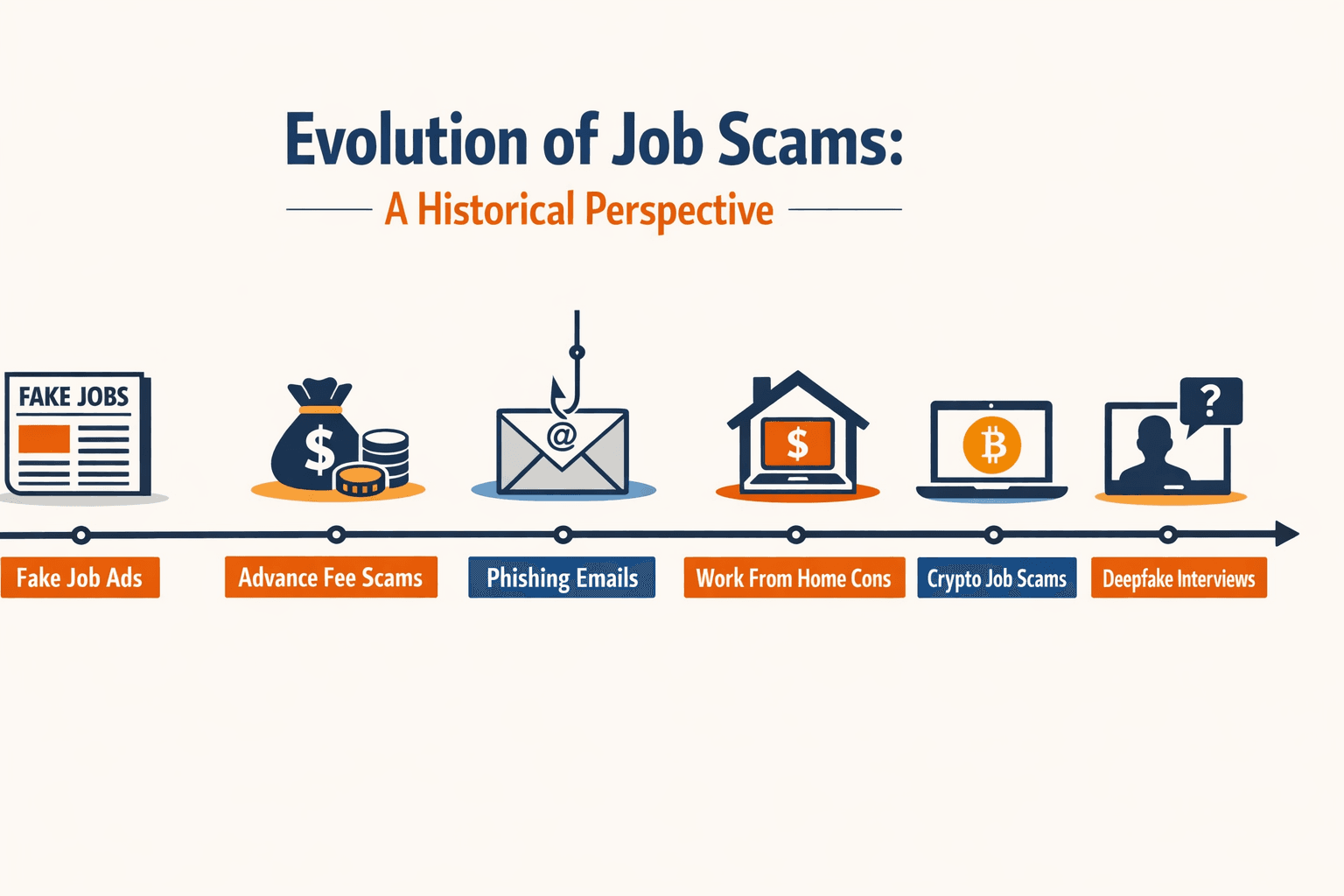
Job scam tactics have shifted dramatically over the decades, adapting to whatever communication channel job seekers trust most. What started as mail-in schemes moved to phone calls, then email phishing, and now sophisticated social media impersonations. The core mechanics stay consistent—build false trust, create urgency, extract money or information—but the delivery method evolves with technology.
From Paper to Digital Fraud
Early job scams relied on classified ads in newspapers and direct mail campaigns. Scammers would post fake positions requiring upfront fees for training materials or background checks. Victims mailed checks and never heard back. As one industry observer noted, "What's old is new. You used to see mail-in scams, and this is almost the new online version." The shift to digital channels didn't change the fundamental approach—it just accelerated the scale and reach.
Email became the primary vector in the early 2000s, with mass phishing campaigns targeting desperate job seekers. Scammers could now reach thousands of people instantly with minimal cost. The tactics remained familiar: fake job offers, requests for personal information, demands for processing fees. The difference was speed and volume.
The AI-Powered Sophistication Wave
Modern job fraud has become harder to spot because scammers now use professional tools that weren't available before. AI-powered writing assistants help create polished job descriptions and correspondence that mirror legitimate company communications. Fake websites look identical to real corporate career pages, complete with stolen branding and employee photos.
Scammers also leverage social engineering more effectively now. They research targets on LinkedIn, reference real employees, and mimic actual hiring processes with multiple interview rounds. Some even conduct video calls using deepfake technology or stolen executive footage. The old red flags—poor grammar, generic email addresses—don't always apply anymore.
Platform-Specific Tactics
Each new job platform brings new scam variations. On LinkedIn, fraudsters create fake recruiter profiles with hundreds of connections to appear legitimate. They message candidates directly, bypassing traditional application systems. On Indeed and ZipRecruiter, they post positions that redirect to external sites where the real scam begins.
Messaging apps like WhatsApp and Telegram have become popular for hiring innovations and unfortunately for scams too. Scammers move conversations off official platforms quickly, making it harder for companies to monitor or intervene. They'll conduct entire fake hiring processes through encrypted chat, then request payment for equipment or training at the final stage.
Cryptocurrency has added another layer. Instead of asking for wire transfers or checks, scammers now request Bitcoin or other digital currencies for onboarding fees. These payments are essentially untraceable, making recovery impossible and prosecution difficult.
Impact of Technology on Job Scams
Technology didn't just change how we apply for jobs — it changed how scammers find their targets. The shift from newspaper classifieds to online job boards gave fraudsters global reach overnight. Where a fake ad in the 1980s might trick a few dozen people in one city, today's scam posting can reach thousands across multiple continents before anyone flags it.
The real accelerant was remote work. When companies started hiring across state lines and time zones, the line between legitimate virtual onboarding and a well-crafted scam blurred. Candidates got used to never meeting their manager face-to-face, never visiting an office, and handling everything through email and messaging apps. Scammers walked right through that door.
The Remote Work Window
Remote work and widespread layoffs created perfect conditions for employment fraud. Job seekers under pressure are less likely to question a recruiter who moves fast or asks for information up front. The urgency feels normal when you're competing with hundreds of other applicants for every opening.
Online job boards made volume possible. A scammer can post dozens of fake roles in an afternoon, each one tailored to trending job titles. The postings look identical to real ones — same formatting, same language, same application flow. By the time the platform removes them, the damage is done.
Automation and Scale
Technology also gave scammers tools to automate their operations. Bulk email software, fake company websites that clone real brands, and chatbots that conduct initial "screening interviews" all make scams cheaper to run and harder to detect. What used to require a phone call and a convincing voice now happens through a scripted chat window.
Social media added another layer. Scammers scrape LinkedIn for profiles that match their target roles, then reach out with personalized messages that reference your actual work history. The approach feels credible because it is personalized — just not by a real recruiter. For more on how technology is reshaping recruitment practices, see our guide on hiring innovations.
When your entire hiring process happens through screens, the only thing protecting you is your ability to verify what you're seeing.
The Verification Gap
The gap between how fast technology moves and how slowly people adapt is where scams thrive. Job seekers know they should verify a company's legitimacy, but they don't always know how — or they skip the step because the offer feels urgent. Scammers exploit that gap by creating just enough digital presence to pass a quick Google search: a website, a LinkedIn company page, maybe a few fake employee profiles.
The platforms themselves are playing catch-up. Job boards have added verification features and fraud reporting, but the volume of postings makes manual review impossible. Automated filters catch some scams, but the sophisticated ones slip through by mimicking real postings almost perfectly.
Case Studies of Notable Job Scams
Job scams aren't abstract threats—they're real schemes that cost real people time, money, and trust. Looking at specific cases shows how these frauds actually work and what makes them effective. The patterns repeat, but the packaging keeps changing.
The Task-Based Product Rating Scam
Fadia in Texas thought she'd landed a straightforward gig rating products for an online store. The setup looked legitimate: complete simple tasks, submit reviews, earn money. She followed instructions, invested her time, and believed she was building a work relationship with a real company.
The scam worked because it mimicked genuine remote work. Task-based schemes exploit the gig economy's structure—short assignments, digital communication, no face-to-face contact. By the time victims realize the "employer" has disappeared or the payment will never arrive, they've already handed over personal information or even upfront fees for training materials.
The Classic Trifecta: Fake Opportunities, Work-at-Home Schemes, and Shady Agencies
Every day, job seekers encounter phony business opportunities, work-at-home scams, and questionable employment agencies. These aren't isolated incidents—they're industrial-scale operations targeting people who need work.
Work-at-home scams promise flexibility and income but deliver neither. Fake business opportunities sell you on becoming your own boss, then charge for starter kits or training that leads nowhere. Shady agencies collect fees for job placements that don't exist or interviews that never materialize.
What ties these together is the upfront ask. Legitimate employers pay you; scammers make you pay them. The pitch changes—envelope stuffing, mystery shopping, reshipping goods—but the core mechanism stays the same: extract money before providing anything of value.
The clearest signal of a job scam is being asked to pay before you work—real employers never charge application fees, training costs, or equipment deposits.
Why These Scams Succeed
These cases work because they exploit urgency and hope. When you need income, a quick-start opportunity looks attractive. When the job market feels tight, you're more willing to overlook red flags. Scammers know this and design their pitches accordingly.
The task scam gave Fadia immediate work. The work-at-home schemes promise immediate income. The fake agencies promise immediate interviews. Speed is the hook—legitimate hiring takes time, involves multiple conversations, and never demands payment from candidates.
Understanding these patterns helps you spot the next variation before it costs you. For more insights on navigating the modern job market safely, see our guide on job offer pitfalls.
The Current State of Job Scams
Job scams aren't slowing down — they're accelerating. Reports of employment fraud doubled in 2025 compared to the previous year, and nearly 50,000 people filed complaints with BBB Scam Tracker over a recent three-year period. The FTC puts the financial damage at over $500 million lost to job and employment scams in 2023 alone. These aren't small-time operations; they're coordinated schemes that exploit the scale and anonymity of online hiring.
What makes today's landscape different is the professionalization of the scam. Fraudsters now mirror legitimate hiring workflows — multi-round interviews, detailed job descriptions, even fake HR portals that look identical to real company systems. In high-volume recruiting environments, I've seen scammers impersonate our own job postings within hours of publication, copying logos, language, and even recruiter names from LinkedIn. The speed and sophistication make it harder for job seekers to distinguish real opportunities from traps.
Common Scam Types in Today's Market
The most prevalent scams fall into a few categories. Fake check schemes remain popular: you're "hired" remotely, sent a check to buy equipment, then asked to wire back the excess before the check bounces. Reshipping scams recruit you as a "logistics coordinator" to receive stolen goods and forward them overseas. Advance fee scams demand payment for background checks, training materials, or certification before you start — fees that legitimate employers never require upfront.
Another rising threat: data harvesting scams that pose as applications but exist solely to collect Social Security numbers, bank details, and identity documents. These don't even pretend to hire you — they vanish once they have your information. The job offer pitfalls you need to watch for often start at the application stage, not after an offer arrives.
Who Gets Targeted
Scammers cast wide nets, but certain groups face higher risk. Remote job seekers see more scams because the entire interaction happens online, removing the credibility check of an in-person interview. Entry-level candidates and recent graduates get targeted heavily — they have less hiring experience to spot red flags and often feel pressure to accept quickly. International job seekers are especially vulnerable when scammers exploit visa anxieties or unfamiliarity with local hiring norms.
The best scams don't look like scams — they look like the job you've been searching for all month.
The current state isn't just about volume; it's about precision. Fraudsters scrape LinkedIn, tailor their pitches to your profile, and time their outreach to moments of maximum vulnerability — right after a layoff, during active job searches, or when you've publicly posted about needing work. Vigilance isn't optional anymore; it's a core job search skill.
How to Identify Job Scams
Spotting a fake job posting before you waste hours tailoring your resume—or worse, hand over personal information—comes down to pattern recognition. Scammers leave tells, and once you know what to look for, most fraudulent listings collapse under basic scrutiny.
Red Flags in Job Scam History
Generic job titles paired with vague descriptions are the first warning sign. If a posting reads "Sales Associate" but never names the product, industry, or day-to-day responsibilities, the employer either doesn't exist or doesn't care who applies. Real hiring managers write specifics because they need to filter candidates, not collect resumes.
Salary ranges that seem detached from reality—entry-level roles promising six figures with no experience required—are bait. Legitimate employers anchor compensation to market rates and skill requirements. If the pay feels like a lottery win for minimal qualifications, it's designed to hook desperate job seekers, not hire them.
Requests for sensitive information upfront, especially before any interview, are immediate disqualifiers. No real recruiter asks for your Social Security number, bank details, or payment for training materials in the application phase. I've screened thousands of candidates at Meta and Chipper Cash; we collect tax documents after the offer is signed, not before we've spoken to you.
Common Fraud Detection Checklist
Poor grammar and spelling errors throughout the posting signal either carelessness or a scammer operating outside professional norms. Typos happen, but a listing riddled with mistakes suggests no one with hiring authority reviewed it. Cross-reference the company name and job title on the employer's official careers page; if it doesn't appear there, it doesn't exist.
Pressure tactics—"Apply now, offer expires tonight!"—exploit urgency to bypass your skepticism. Real roles have application windows, but they don't manufacture artificial deadlines to force snap decisions. When a recruiter rushes you to provide personal data or accept terms before you've had time to verify anything, that's a scam mechanic, not a hiring process.
Upfront payment requests for training, certifications, or "onboarding fees" are scams, full stop. Employers invest in employees; they don't charge admission. If someone wants money before you've worked a single hour, they're not hiring you—they're billing you.
The fastest way to spot a fake job is to ask yourself: would a real hiring manager write this, or does it read like a template designed to collect clicks?
Verify the recruiter's identity by searching their name and title on LinkedIn, then cross-checking with the company's employee directory or public team pages. Scammers impersonate real recruiters, but they rarely maintain full professional profiles with years of activity and mutual connections. If the person contacting you has no LinkedIn presence or a profile created last week, that's a red flag worth investigating. For more on how legitimate hiring processes work, see our guide on hiring innovations.
Research the company independently—not just the website linked in the job ad, but third-party reviews, news coverage, and employee testimonials on Glassdoor or similar platforms. A company with no digital footprint beyond a slick landing page is either brand new or nonexistent, and brand-new companies don't usually run high-volume hiring campaigns for remote roles with inflated salaries.
Protecting Yourself Against Job Scams
The best defense against job scams is a healthy dose of skepticism combined with a few verification habits. You don't need to become paranoid, but you do need to treat every unsolicited job offer like a claim that requires proof. Scammers count on urgency and excitement to short-circuit your judgment; slowing down is half the battle.
Verify the Company Before You Engage
When a recruiter reaches out or you find a promising posting, go straight to the company's official website and search for the job there. If it's not listed on their careers page, that's a red flag. Contact the company's HR department using the email or phone number published on their site—not the contact info the recruiter gave you. A legitimate recruiter won't be offended by verification; a scammer will evaporate.
I've seen candidates waste weeks in fake interview loops because they skipped this step. One engineer I worked with nearly handed over his passport and bank details to a "recruiter" who claimed to represent a well-known tech firm. A two-minute check of the company's actual careers page would have saved him the trouble.
Never Pay to Get Hired
No legitimate employer charges application fees, training fees, background check fees, or equipment deposits. If someone asks you to pay for anything as part of the hiring process, it's a scam. Full stop. Real companies absorb those costs; they're hiring you because they need your work, not your wallet.
Scammers often frame these requests as "refundable deposits" or "processing fees." They'll promise reimbursement on your first paycheck. That paycheck will never come.
Protect Your Personal Information
You shouldn't be asked for your Social Security number, bank account details, or copies of your driver's license until after you've accepted a written offer and begun formal onboarding. Early requests for sensitive data—especially before you've had a real interview—are a clear warning sign.
Be cautious about what you include on public job boards, too. Your resume doesn't need your full address, date of birth, or references until you're deep in the process. Scammers scrape boards for targets; the less you give them, the harder you are to exploit.
The FTC has made it clear: protecting workers from fraudulent hiring practices is a priority, and job seekers have every right to verify before they trust.
Research the Recruiter and the Offer
Look up the recruiter's name and the company on LinkedIn. Does the recruiter's profile match the company they claim to represent? Do they have a history and connections that make sense? If their profile was created last week and has no network, you're likely dealing with a fake account.
Search for the company name plus "scam" or "fraud" in Google. You'll often find complaints from other job seekers who've been targeted by the same operation. Trust patterns over promises.
For additional guidance on navigating the hiring landscape and avoiding common pitfalls, see our article on job offer pitfalls.
Trust Your Instincts
If an offer feels too good to be true—high pay for minimal qualifications, instant hire without an interview, work-from-home with no experience required—it probably is. Scammers exploit desperation and hope. The more eager you are, the less you question. Slow down, verify, and remember: a real opportunity will still be there tomorrow.
Future of Job Scams
Job scams aren't standing still — they're evolving faster than most organizations can adapt. The same forces reshaping legitimate hiring are also arming scammers with better tools, wider reach, and more convincing cover stories. If you're recruiting or job hunting in the next few years, the fraud landscape will look different than it does today.
AI-Powered Impersonation
Artificial intelligence is making scams harder to spot. Job fraud has evolved dramatically with AI tools, making scams appear more polished and professional than before. Fake job postings now feature grammatically perfect descriptions, personalized outreach emails, and even dynamically generated "company" websites that look legitimate at first glance. Scammers can spin up entire hiring funnels — application forms, interview scheduling pages, offer letter templates — in hours, not weeks.
The old tells (broken English, generic greetings, obvious typos) are disappearing. When a scam email reads like it came from your actual talent acquisition team, the margin for error shrinks fast.
Deepfakes and Voice Cloning
We're approaching a point where scammers can impersonate real hiring managers in video interviews. Deepfake technology is already good enough to fool casual observers, and voice-cloning tools can mimic a recruiter's cadence and tone from a few seconds of audio scraped off a podcast or LinkedIn video. Expect to see "virtual interviews" where the person on the other end isn't who they claim to be — or isn't a person at all.
For candidates, this means verifying the legitimacy of every interview invitation through a second channel (a direct call to the company's main line, a LinkedIn message to the recruiter's verified profile). For recruiters, it means tightening identity verification on your own end — because scammers will impersonate you to steal data from applicants.
Targeting Remote and Gig Workers
Remote work opened the floodgates for global hiring. It also opened them for global scams. As more companies hire across borders and more workers chase flexible arrangements, scammers are tailoring pitches to remote-first roles: "work from anywhere," "no experience required," "start immediately." These aren't inherently red flags anymore — plenty of legitimate remote jobs use the same language — which is exactly why scammers love them.
Gig platforms and freelance marketplaces will see more sophisticated fraud: fake clients requesting work upfront, phishing schemes disguised as onboarding paperwork, payment scams dressed up as direct deposit forms. The line between a bad client and an outright scam will get blurrier.
Recycled Tactics in New Wrappers
Not everything will be cutting-edge. As one expert put it: "What's old is new. You used to see mail-in scams, and this is almost the new online version." Advance-fee schemes, fake check deposits, and equipment purchase scams will keep circulating — just dressed up in Slack channels, Zoom calls, and DocuSign requests instead of postal mail.
The fundamentals don't change: scammers need you to send money, share credentials, or provide personal data before you realize the job doesn't exist. The delivery mechanism evolves, but the hook stays the same. If you understand the hiring innovations shaping legitimate recruitment, you'll also spot when someone's weaponizing those same trends to run a con.
What This Means for You
Staying ahead of job scams in the next few years means treating verification as a non-negotiable step, not an optional precaution. Cross-check every opportunity through multiple channels. If an offer arrives faster than the interview process justifies, slow down and ask questions. If a recruiter's communication style shifts mid-conversation (suddenly more formal, suddenly more urgent), that's a signal worth investigating.
Scammers will keep adapting. Your defenses need to adapt faster.
Conclusion
Job scam history reveals a clear pattern: fraud evolves alongside legitimate hiring practices. From newspaper classified cons in the early 1900s to today's AI-powered impersonation schemes, scammers adapt their tactics to exploit whatever medium job seekers trust most. The fundamentals haven't changed—fake opportunities designed to extract money or personal information—but the delivery mechanisms grow more sophisticated every year.
The data underscores the scale of the problem. Consumers lost over $500 million to employment scams in 2023 according to the FTC, a figure that represents only reported losses. Many victims never come forward, either from embarrassment or because they don't realize they've been scammed until months later when identity theft surfaces.
Awareness is your first line of defense. Understanding how job scams have evolved—from advance-fee schemes to fake remote work offers to credential-harvesting interview processes—helps you recognize the warning signs before you hand over money or sensitive data. No legitimate employer asks you to pay for training materials, requests your banking details before an offer, or conducts entire hiring processes through messaging apps.
In my 25 years in talent acquisition, I've seen scammers shift from crude email blasts to polished operations that mimic real companies down to the domain name. At Meta, where I sourced AI engineers at volume, I learned that scammers study real job postings and copy the language, the benefits, even the interview structure. The best protection is skepticism paired with verification: check the company website directly, call the main number, search for the recruiter's LinkedIn profile before you engage.
Staying informed about job offer pitfalls and maintaining healthy skepticism throughout your search will keep you several steps ahead of most scam operations. The job market is competitive enough without losing time and money to fraud. Trust your instincts, verify every detail, and remember that any offer requiring upfront payment is a scam—no exceptions.

Written by
John Cronin
Published August 22, 2026 · 22 min read
John Cronin is a talent-acquisition leader with 25 years in recruiting, most recently as a Principal Technical Recruiter at Meta hiring machine-learning and AI engineers. He has been a founding recruiter at GoPro and Chipper Cash and led talent acquisition at Imgur. He writes about what recruiters actually do with your resume.
Want this kind of read on your résumé?
We'll tell you what's actually working, what's holding you back, and what to fix — in plain English.
Get My Job Match ScoreYou Might Also Like
More articles to help you advance your career

Employment Law: 10 Must-Know Penalties for Fake Job Listings
Discover the best employment law penalties for fake job listings. Learn the must-know legal implications and consequences employers face today.

Job Listing Checks: 10 Essential Steps to Protect Yourself
Master job listing checks with 10 essential steps to protect yourself from scams and verify employment opportunities before applying online.