

ATS Resume Tips: 9 Essential Steps for Stress-Free Success
Master ATS resume tips with 9 essential steps to optimize your resume, land more interviews, and stand out in today's competitive hiring process.
 Emily Johnson
Introduction
Key Takeaways
- Applicant Tracking Systems parse and rank resumes before human recruiters see them, making ATS optimization essential in 2026
- Strategic keyword integration and clean formatting are critical to passing ATS filters without triggering overstuffing detection
- A customized, section-by-section approach transforms resumes from invisible to interview-ready
- Modern ATS systems are increasingly sophisticated, requiring both technical optimization and authentic presentation
- Testing and refining your resume ensures it works for both automated systems and human decision-makers
When I first started working with Applicant Tracking Systems over a decade ago, I was amazed by how quickly they transformed the recruitment process. Fast forward to 2026, and these systems have become even more sophisticated. An Applicant Tracking System is software employers use to parse resumes, extract hard-skill terms, and rank candidates against a job description before a human recruiter reviews applicants.
Recently, I had a client who, despite an impressive background, struggled to pass the initial ATS screening. We worked together to transform his resume, focusing on customized content that mirrored the specific job descriptions he was targeting. We started by ensuring the use of relevant keywords and phrases that matched the job listings he was interested in, incorporating these terms naturally throughout the resume without overstuffing.
We also focused on clarity and format consistency, understanding how ATS systems parse resumes. To ensure your resume parses correctly, prioritize text structure over design by using standard formatting such as left-aligned text, standard bullet points, and consistent font sizes. By simplifying the design, avoiding complex graphics, and using standard fonts, his resume became significantly more ATS-friendly.
The transformation was dramatic. Not only did his resume start passing through ATS filters with ease, but he also started receiving more interview calls. This experience reinforced the importance of staying updated on ATS resume tips and adapting to technological advances in the job market.
In this guide, I'll walk you through nine essential steps that will help you master ATS optimization in 2026. You'll learn how to conduct strategic keyword research, format your resume for maximum parseability, customize each section effectively, and test your results. Whether you're a recent graduate or a seasoned professional, these strategies will help you navigate the digital gatekeepers and land more interviews. Crafting a resume that is both ATS and human-friendly is an art, and I'm here to help you master this balance.
Sources
Understanding How ATS Works in 2026
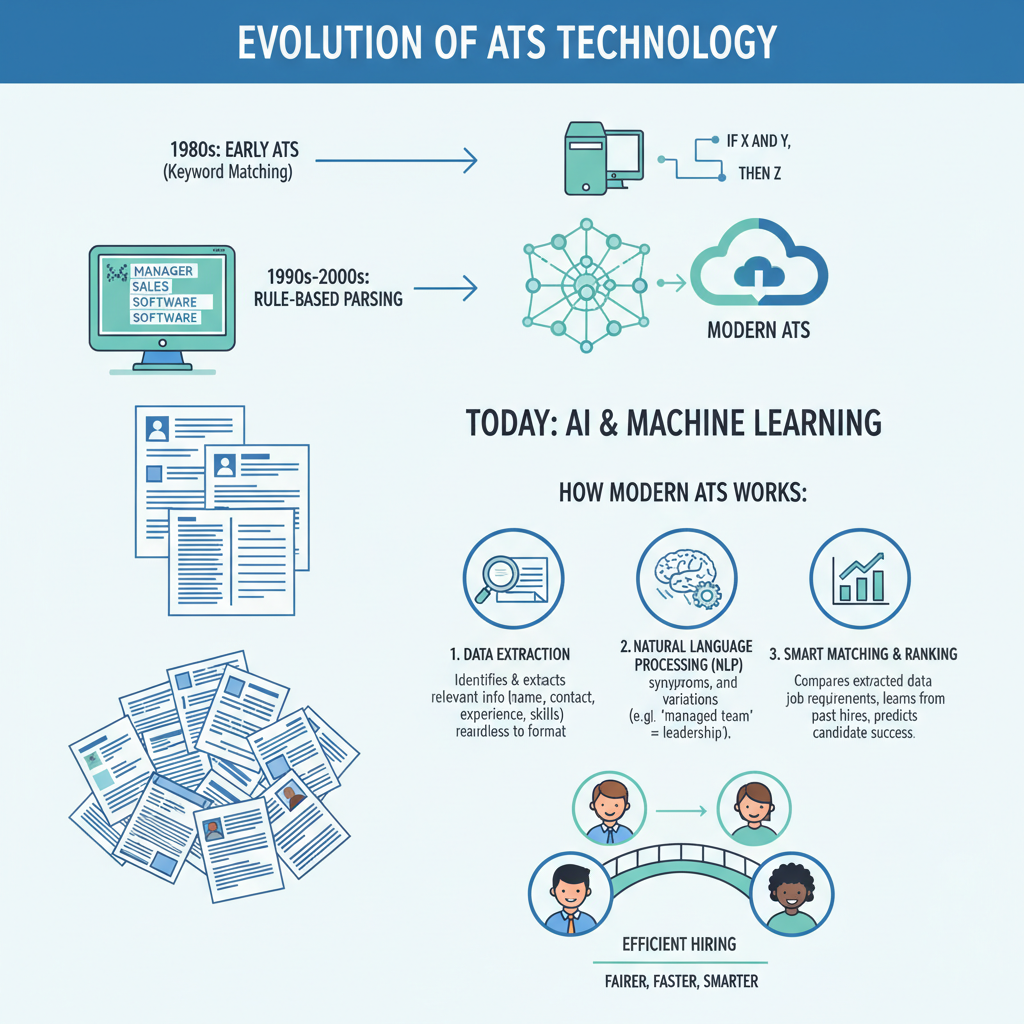
Applicant Tracking Systems have evolved significantly over the past decade, transforming from simple keyword-matching tools into sophisticated platforms that screen, parse, and rank resumes with remarkable precision. In 2026, understanding how these systems work is no longer optional—it's essential for anyone serious about landing interviews in today's competitive job market.
The Current State of ATS Adoption
The numbers tell a compelling story about ATS prevalence in modern hiring. More than 95% of Fortune 500 companies now use Applicant Tracking Systems or AI-powered resume screening tools to manage their recruitment processes. This widespread adoption extends far beyond large corporations, with countless mid-sized employers worldwide implementing these systems to handle the volume of applications they receive.
The stakes are high for job seekers. A staggering 75% of resumes were rejected outright by an ATS in 2026 before they ever reached a recruiter. This rejection rate underscores why mastering ATS optimization has become a critical skill in any job search strategy.
How Modern ATS Platforms Parse Your Resume
Today's ATS platforms use advanced parsing technology to extract information from your resume and organize it into structured data fields. When you submit your application, the system scans your document and attempts to identify key sections such as work experience, education, skills, and contact information.
The parsing process breaks down your resume into individual data points that the system can analyze and compare against the job requirements. Modern systems have become more sophisticated in recognizing various formatting styles, but they still perform best with clean, straightforward layouts that follow conventional resume structures.
Scoring and Ranking Mechanisms
Once parsed, your resume receives a score based on how well it matches the job description. The ATS analyzes keyword frequency, relevance of experience, required qualifications, and other criteria defined by the employer. Resumes that score above a certain threshold move forward in the process, while those below are filtered out.
This scoring system explains why generic, one-size-fits-all resumes rarely succeed. Each job posting has unique requirements, and the ATS is programmed to identify candidates whose backgrounds align most closely with those specific needs. Understanding this mechanism is critical for effective customization.
Why ATS Knowledge Drives Resume Success
Knowing how ATS platforms function empowers you to make strategic decisions throughout your resume creation process. When you understand that the system prioritizes relevant keywords, you know to mirror the language used in job descriptions. When you recognize that complex formatting can confuse parsers, you choose simplicity over elaborate designs.
This foundational knowledge transforms resume writing from guesswork into a strategic exercise. Rather than hoping your qualifications shine through, you can deliberately structure your resume to pass ATS filters while remaining compelling to human recruiters who review it later.
Sources
Strategic Keyword Research: Mining Job Descriptions for Success
The most common reason qualified candidates fail ATS screening isn't a lack of experience—it's what I call the "Keyword Gap." This is the disconnect between the language you use on your resume and the specific terminology the employer is searching for. Bridging this gap starts with strategic keyword research.
Treating Job Descriptions as Your Roadmap
Every job posting is essentially a treasure map to ATS success. Employers embed the exact keywords their systems will prioritize, making the job description your most valuable research tool. Read each posting carefully, highlighting recurring terms, required qualifications, and preferred skills.
Pay special attention to the requirements and qualifications sections. These areas typically contain the hard skills, certifications, and technical competencies that ATS systems weight most heavily. If a posting mentions "project management certification" three times, that's a clear signal of importance.
Identifying the Four Keyword Categories
Effective keyword research means extracting terms across multiple categories:
- Hard skills: Technical abilities like "Python," "financial modeling," or "CAD software"
- Soft skills: Interpersonal qualities such as "cross-functional collaboration" or "stakeholder management"
- Certifications and credentials: Specific qualifications like "PMP," "CPA," or "AWS Certified"
- Industry terminology: Sector-specific language including acronyms, methodologies, and tools
Don't assume synonyms will work. If the posting says "customer relationship management," use that exact phrase rather than "client relations" or "customer service." Modern ATS systems are sophisticated, but exact matching still carries significant weight.
The Mirror Method for Keyword Extraction
Mirror the exact keywords and phrases from the job description instead of using vague descriptions or your own interpretations. Create a simple document where you copy and paste key terms directly from the posting. Group them by category, then cross-reference with your actual experience.
This approach ensures you're speaking the employer's language. If they use "budget oversight," use "budget oversight"—not "financial supervision" or "cost management," even if those sound more sophisticated to you.
Analyzing Multiple Postings for Pattern Recognition
Don't rely on a single job description. Review five to ten postings for your target role across different companies. You'll start noticing patterns—certain keywords appear repeatedly, signaling industry-standard terminology that should definitely appear on your resume.
This pattern analysis also helps you distinguish between must-have qualifications and nice-to-have preferences, allowing you to prioritize which keywords deserve prominent placement in your resume.
Sources
ATS Resume Tips: Formatting That Passes Every Filter
Even the most impressive credentials can vanish into a digital void if your resume formatting confuses the ATS. Modern applicant tracking systems are sophisticated, but they still rely on clear structure and standard formatting to accurately parse your information. Getting the formatting right is one of the most critical ATS resume tips that can make the difference between landing an interview and being automatically rejected.
Choose the Right File Format and Font
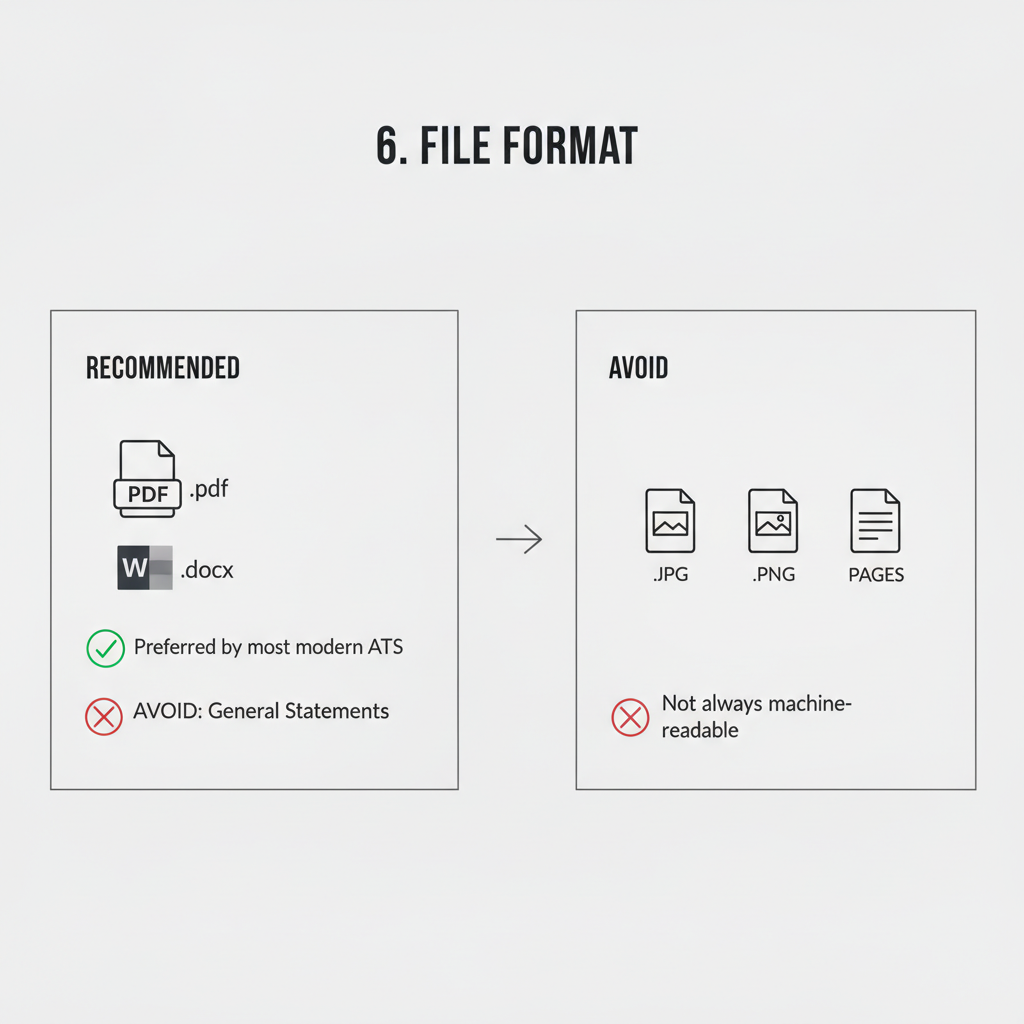
Start with the basics: save your resume as a .docx or .pdf file, as these formats are universally compatible with most ATS platforms. When it comes to typography, stick to standard, web-safe fonts like Arial or Calibri. These fonts ensure your text renders consistently across different systems and devices. Avoid decorative or script fonts that may not parse correctly or could be misread by the software.
Consistency in font size matters too. Use a readable size between 10 and 12 points for body text, and slightly larger sizes for section headers. This creates a clear visual hierarchy that both ATS and human reviewers can follow easily.
Prioritize Text Structure Over Visual Design
The golden rule for ATS-friendly formatting is simple: prioritize text structure over design flourishes. Use standard formatting elements such as left-aligned text, standard bullet points, and consistent spacing throughout your document. A reverse-chronological format works best, with your most recent experience listed first and sections clearly labeled with conventional headers like "Work Experience," "Education," and "Skills."
Stick to a clean, single-column layout. While multi-column designs may look visually appealing, they often confuse ATS parsers, causing your information to be scrambled or misread. Similarly, avoid embedding text boxes, tables, graphics, or symbols, as these elements frequently trigger parsing errors that can render entire sections of your resume unreadable to the system.
Avoid Common Formatting Pitfalls
Certain formatting choices are guaranteed to cause problems with ATS. Headers and footers should be avoided entirely, as many systems cannot read information placed in these areas. This means critical details like your contact information should appear in the main body of your resume, not tucked away in a header.
Two-column layouts, while space-efficient, create confusion for ATS parsers that read left to right. The system may jumble your information, mixing content from both columns in unpredictable ways. Similarly, avoid using special characters, unusual symbols, or complex formatting like shading or background colors. These elements add no value to an ATS and may actively harm your chances of passing the initial screening.
Use Standard Section Headers and Bullet Points
Label your resume sections with conventional, industry-standard headers. Terms like "Professional Experience," "Work History," "Education," and "Technical Skills" are universally recognized by ATS algorithms. Creative alternatives like "Where I've Made an Impact" or "My Journey" may sound engaging to human readers, but they confuse automated systems that are programmed to look for specific section names.
For bullet points, use standard round bullets or simple dashes. Avoid checkmarks, arrows, or custom symbols that may not translate properly. Each bullet point should be concise and start with a strong action verb, making it easy for both the ATS and hiring managers to quickly scan your accomplishments.
Test Your Formatting Before Submitting
Before you submit your resume, take a moment to test how it will appear to an ATS. One simple method is to copy and paste your resume content into a plain text editor. If the information remains clear and well-organized in plain text format, it will likely parse correctly in an ATS. If you notice jumbled sections, missing information, or formatting chaos, you'll need to simplify your design further.
Remember that ATS-friendly formatting doesn't mean your resume has to look boring or unprofessional. A clean, well-structured document with consistent formatting actually appears more polished and easier to read for human reviewers as well. The goal is to create a resume that passes the digital gatekeeper while still making a strong impression once it reaches a real person's desk.
Sources
Section-by-Section Customization Strategy
Tailoring your resume for each job application is no longer optional—it's essential for ATS success. Modern systems rank candidates by analyzing how well each section aligns with job requirements, prioritizing hard skills, education credentials, job title relevance, and soft skills in that order. The key is customizing strategically while maintaining authenticity throughout your document.
Professional Summary: Your ATS Gateway
Your professional summary should mirror the job description's most critical requirements within the first three lines. Extract the top three to five qualifications from the posting and weave them naturally into a compelling narrative. Instead of generic statements, focus on your specific expertise that matches what the employer seeks.
Keep this section concise—three to four sentences maximum. Lead with your current role or professional identity, follow with your most relevant skills and experience, and close with what you bring to the target position. This section sets the tone for both the ATS algorithm and human reviewers.
Experience Section: Achievements Over Responsibilities
The experience section carries the most weight in ATS evaluations. Structure each role with your job title, company name, location, and dates in a clean, consistent format. Then focus on accomplishments rather than generic duties.
AI and recruiters value measurable results over task lists. Transform each bullet point into an achievement statement that includes quantifiable outcomes whenever possible. Instead of "Managed team projects," write "Led cross-functional team of 8 to deliver projects 15% ahead of schedule." This approach satisfies both ATS ranking criteria and human readers.
Align your experience descriptions with the language used in the job posting. If the employer seeks "stakeholder engagement," use that exact phrase rather than "client communication." This precision helps ATS systems recognize your relevance while keeping your content authentic.
Skills Section: Strategic Prioritization
Your skills section deserves careful curation for each application. List hard skills first, as ATS systems prioritize technical competencies over soft skills. Review the job description and identify which skills appear most frequently or are marked as required.
Organize skills into relevant categories if you have extensive expertise, but keep the structure simple. Use the exact terminology from the job posting—if they say "Python," don't substitute "Python programming language." This direct matching improves your ATS score significantly.
Include both acronyms and full terms where appropriate ("Search Engine Optimization (SEO)") to capture different search variations. Limit this section to 10-15 highly relevant skills rather than padding it with every capability you've ever touched.
Education and Certifications: Precise Formatting
Education sections need consistent formatting to ensure proper ATS parsing. List your degree type, major, institution name, and graduation year in a standard order. Avoid creative formatting that might confuse the system.
For certifications, include the full official name, issuing organization, and date obtained. If a certification is specifically mentioned in the job requirements, ensure it appears exactly as written in the posting. This section should be straightforward and factual, allowing ATS to quickly verify your credentials.
Maintaining Authenticity While Customizing
Customization doesn't mean fabrication. Every tailored element should reflect genuine skills and experiences you possess. The goal is emphasizing the most relevant aspects of your background for each specific opportunity, not creating fiction.
Review each customized section to ensure it still sounds like you and accurately represents your professional story. The best ATS-optimized resumes pass both algorithmic screening and human scrutiny because they're built on a foundation of authentic achievement and relevant expertise.
Sources
Natural Keyword Integration Without Overstuffing
The art of keyword integration lies in making your resume both ATS-friendly and genuinely readable. Modern ATS algorithms in 2026 are sophisticated enough to detect keyword stuffing, which can actually hurt your chances rather than help them. The goal is to weave relevant terms seamlessly into your experience and achievements.
Mirror Job Description Language Precisely
One of the most effective ATS resume tips is to use exact keyword phrases from the job posting rather than synonyms or vague descriptions. If a job description asks for "Global Logistics" experience, listing only "Shipping" on your resume will rank you below candidates who explicitly mention "Global Logistics." This precision matters because ATS systems match specific terms, not general concepts.
Pay close attention to how employers phrase their requirements. If they write "project management," use that exact phrase instead of "managed projects." If they specify "stakeholder engagement," don't substitute "client communication." This mirroring approach ensures your resume aligns perfectly with what the system is programmed to find.
Integrate Keywords Contextually
Rather than creating a keyword-dense paragraph that reads awkwardly, distribute relevant terms naturally throughout your resume sections. Mention key skills in your professional summary, incorporate them into your job descriptions, and reference them when describing specific projects or achievements.
For example, instead of writing "Responsible for project management, team leadership, budget management, and stakeholder engagement," try: "Led cross-functional teams through complex project lifecycles while managing $2M budgets and maintaining regular stakeholder engagement." The second version includes the same keywords but reads naturally and provides context.
Use Variations Strategically
While exact phrase matching is crucial, you can also include natural variations of key terms. If "data analysis" appears in the job description, you might use "analyzed data" in one bullet point and "data analysis" in another. This approach demonstrates genuine experience rather than mechanical keyword insertion.
Avoid repeating the same phrase multiple times in a single section. If you've mentioned "customer relationship management" in your summary, use it in your experience section in a different context rather than repeating it verbatim in consecutive bullets.
Let Your Authentic Experience Guide Keyword Placement
The most effective keyword integration happens when you're describing work you've actually done. If a keyword feels forced or doesn't fit your experience, it's better to omit it than to insert it awkwardly. ATS systems in 2026 can detect unnatural patterns, and human recruiters will certainly notice disconnected or inflated claims.
Focus on keywords that genuinely reflect your skills and accomplishments. This authenticity not only helps you pass ATS filters but also ensures you can speak confidently about every term on your resume during interviews.
Sources
Quantifying Achievements in ATS-Friendly Language
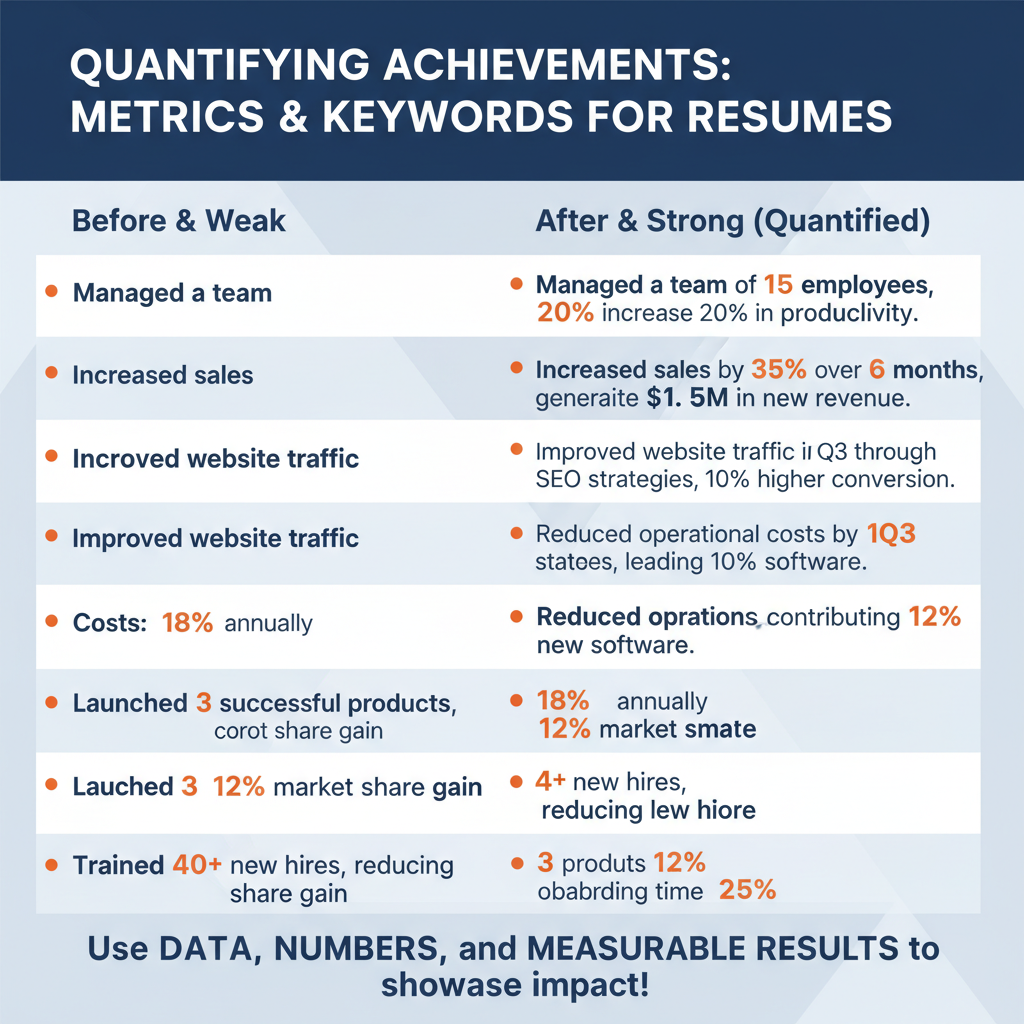
Numbers speak louder than words—especially to both ATS algorithms and human recruiters. When you quantify your achievements, you transform vague responsibilities into concrete evidence of your impact. Modern ATS systems in 2026 are designed to recognize and prioritize measurable results, making this one of the most powerful strategies in your resume optimization toolkit.
Why Metrics Matter for ATS and Recruiters
Both AI screening tools and recruiters value measurable results over generic responsibilities. When you include achievements with quantifiable outcomes, you provide clear proof of your capabilities. Instead of stating "managed a team," you might write "led a team of 12 sales representatives, increasing quarterly revenue by 28%." This approach satisfies ATS keyword requirements while giving recruiters the concrete data they need to assess your fit.
The difference is dramatic. A resume filled with action verbs and numbers demonstrates impact in a way that generic job descriptions never can. ATS systems scan for these indicators of success, and recruiters use them to quickly evaluate whether you can deliver similar results for their organization.
Types of Metrics That Strengthen Your Resume
Effective quantification goes beyond simple percentages. Consider incorporating:
- Revenue and cost metrics: "Reduced operational costs by $150,000 annually" or "Generated $2.3M in new business"
- Time-based improvements: "Decreased project delivery time by 35%" or "Accelerated onboarding process from 6 weeks to 3 weeks"
- Scale and scope indicators: "Managed portfolio of 45 client accounts" or "Oversaw budget of $1.2M"
- Efficiency gains: "Improved customer satisfaction scores from 72% to 91%" or "Reduced error rate by 40%"
- Growth metrics: "Expanded team from 5 to 18 members" or "Increased social media engagement by 250%"
These specific numbers help ATS systems identify you as a results-driven candidate while giving recruiters tangible evidence of your contributions.
Integrating Keywords with Quantified Achievements
The most effective approach combines target keywords with measurable outcomes. If the job description emphasizes "project management" and "stakeholder communication," you might write: "Led cross-functional project management initiatives for 8 concurrent projects, maintaining 100% on-time delivery while coordinating stakeholder communication across 4 departments."
This technique ensures your achievements are both ATS-friendly and compelling to human readers. You're not just listing keywords—you're demonstrating how you've applied those skills to achieve meaningful results. The numbers provide context and credibility, while the keywords ensure your resume passes the initial screening.
Formatting Numbers for Maximum ATS Compatibility
While creativity is valuable in many contexts, ATS systems prefer straightforward number formatting. Use these guidelines:
- Write out "percent" or use the % symbol consistently throughout your resume
- Use standard number formats: "$50,000" rather than "50K" or "fifty thousand dollars"
- Spell out numbers one through nine, use numerals for 10 and above (unless starting a sentence)
- Include time frames to add context: "within 6 months" or "over a 2-year period"
Consistency matters. Choose a formatting style and maintain it across all sections of your resume. This helps ATS systems parse your information accurately while creating a professional appearance for human reviewers.
When You Don't Have Hard Numbers
Not every achievement comes with a precise metric, but you can still convey impact. Use estimates when appropriate: "Managed approximately 30 vendor relationships" or "Supported a team of 10+ engineers." You can also quantify frequency: "Delivered weekly presentations to executive leadership" or "Processed an average of 50 customer inquiries daily."
Even without exact figures, you can demonstrate scale and scope. Instead of "responsible for training," write "developed and delivered training program for new hires across 3 regional offices." The specificity helps both ATS systems and recruiters understand the breadth of your experience.
Sources
Optimizing Your Skills Section for Maximum ATS Impact
Your skills section is one of the first places an ATS looks when ranking your resume. Modern systems prioritize hard skills above nearly everything else, making this section critical for passing initial filters. A well-optimized skills section doesn't just list what you know—it strategically matches the job requirements while maintaining authenticity.
Balance Technical Skills with Job-Specific Requirements
Start by identifying the technical skills explicitly mentioned in the job description. These might include software platforms, programming languages, industry-specific tools, or methodologies. List these skills using the exact terminology from the posting. If the job description mentions "Salesforce CRM," use that exact phrase rather than just "CRM experience."
Include certifications and credentials that align with the role. If you hold relevant certifications, list them clearly with their full names and any associated credentials. This helps the ATS recognize your qualifications and can significantly boost your ranking.
Structure Your Skills Section for ATS Recognition
Use standard section headings that ATS systems easily recognize. Stick with clear labels like "Skills," "Technical Skills," or "Core Competencies." Avoid creative headings that might confuse the parsing algorithm.
Organize your skills in a clean, scannable format. Bullet points work well, as do simple comma-separated lists. Avoid tables, text boxes, or columns that can disrupt how the ATS reads your information. The goal is to make it effortless for the system to extract and categorize each skill.
Include Soft Skills Strategically
While ATS systems prioritize hard skills, don't completely neglect soft skills—especially if they appear in the job description. Terms like "project management," "cross-functional collaboration," or "stakeholder communication" can appear in your skills section if they're relevant to the role.
However, keep the ratio appropriate. Your skills section should be weighted toward technical competencies, with soft skills serving as supporting elements. If the job posting emphasizes leadership or communication, include those terms where they naturally fit.
Match Job Title Alignment and Industry Language
Pay attention to how skills are described in your industry. Different sectors may use different terms for similar competencies. Research common terminology in your field and ensure your skills section reflects current industry language. This alignment helps the ATS recognize your qualifications within the proper context.
Update your skills section for each application. While your core competencies may remain consistent, the emphasis and order should shift based on what each specific role prioritizes. Place the most relevant skills at the top of your list, as some ATS systems weight earlier mentions more heavily.
Sources
Testing and Refining Your ATS-Optimized Resume
Creating an ATS-friendly resume is only half the battle—testing it ensures your carefully crafted document will actually make it through the filters. Before you submit your resume to any application portal, you need to verify that the formatting, keywords, and structure will parse correctly. Think of this step as quality assurance for your job search.
The most effective way to test your resume is to convert it to plain text and review how the information appears. Copy your entire resume and paste it into a basic text editor like Notepad or TextEdit. This simulation mimics how many ATS systems extract and read your content. If sections appear jumbled, bullets turn into strange symbols, or your contact information is scattered, you'll need to simplify your formatting further.
File Format Verification
One of the simplest yet most critical testing steps involves choosing the right file format. Use .docx file format for resumes unless a job posting specifies PDF. While text-based PDFs with selectable content are generally acceptable, .docx files offer the highest compatibility across different ATS platforms. Save your resume with a clear, professional filename that includes your name, such as "Emily-Johnson-Resume.docx" rather than generic labels like "Resume.docx."
Keyword Density Analysis
After confirming your formatting works, analyze whether you've included the right keywords in appropriate quantities. Read through your resume and highlight every instance where you've used terms from the job description. You should see these keywords distributed naturally across multiple sections—your summary, experience bullets, and skills list. If certain critical terms appear only once or not at all, revise those sections to incorporate them more thoroughly without forcing awkward repetition.
Pay attention to keyword variations as well. If the job posting mentions "project management" and "managing projects," try to include both phrasings naturally. ATS systems vary in their ability to recognize synonyms and related terms, so covering your bases with multiple relevant variations increases your chances of ranking well.
Iterative Refinement Strategy
Testing your resume should be an ongoing process, not a one-time check. Each time you customize your resume for a new position, run through these verification steps again. Create a simple checklist that includes format testing, keyword review, and a final proofread for typos or grammatical errors that could hurt your credibility with human reviewers.
Consider asking a trusted colleague or mentor to review your resume as well. They can spot issues you might miss and provide feedback on whether your accomplishments come across clearly. Sometimes what seems obvious to you may not translate well to someone unfamiliar with your background.
Remember that ATS optimization serves a dual purpose—it helps you pass the initial screening and makes your resume easier for recruiters to scan quickly. A well-structured, keyword-rich resume that tests successfully will perform better at every stage of the hiring process, from automated filters to human decision-makers.
Sources
Conclusion
Mastering ATS resume tips isn't just about getting past automated filters—it's about presenting your qualifications in a way that serves both technology and the human recruiters who ultimately make hiring decisions. The nine essential steps we've covered provide a comprehensive framework for creating resumes that successfully navigate modern applicant tracking systems while maintaining the clarity and impact that impress hiring managers.
The reality is stark: a significant portion of resumes never reach human eyes because they fail ATS screening. By implementing strategic keyword research, clean formatting, natural integration of relevant terms, and section-by-section customization, you position yourself ahead of candidates who overlook these critical details. Remember that every job application deserves a tailored approach—generic resumes simply don't perform in today's competitive landscape.
The Dual Audience Strategy
Your resume must speak two languages fluently. First, it needs to communicate with ATS algorithms through proper formatting, relevant keywords, and structured data. Second, it must engage human readers with compelling achievements, clear value propositions, and professional presentation. The strategies outlined in this guide ensure you excel at both.
This dual-audience approach has transformed countless job searches in my career coaching practice. When candidates commit to customizing their resumes for each opportunity and staying current with ATS best practices, the results speak for themselves—more interviews, better opportunities, and reduced job search stress.
Taking Action
Start by auditing your current resume against the formatting guidelines we discussed. Test it using the methods from the previous section, then systematically apply each optimization strategy. Focus first on the fundamentals—clean formatting and strategic keyword placement—before refining the details of achievement quantification and skills optimization.
The investment you make in ATS optimization pays dividends throughout your job search. Each application becomes more effective, your confidence grows, and you gain control over a process that often feels overwhelming. These ATS resume tips aren't just technical requirements—they're your roadmap to stress-free success in the modern hiring landscape.
Approach each application as an opportunity to demonstrate both your qualifications and your professionalism. The care you put into crafting an ATS-optimized, recruiter-friendly resume signals the same attention to detail you'll bring to your next role.
Sources

Written by
Emily Johnson
Published March 2, 2026 · 26 min read
Emily Johnson is a seasoned career strategist with over a decade of experience in recruitment and talent acquisition. With a background in human resources, she excels at helping professionals refine their job search strategies, from crafting compelling resumes to mastering interview techniques. As an expert in Applicant Tracking Systems (ATS), Emily is dedicated to guiding individuals toward their dream careers.
Want this kind of read on your résumé?
We'll tell you what's actually working, what's holding you back, and what to fix — in plain English.
Get My Job Match ScoreYou Might Also Like
More articles to help you advance your career

Portfolio Building: 9 Essential Steps for Easy Success
Master portfolio building with 9 essential steps. Create professional portfolios that showcase your work and significantly boost your job prospects.
Resume Analysis: 9 Simple Expert Tips for Ultimate Improvement
Resume analysis boosts your job prospects with effective strategies for a standout, ATS-friendly resume. Learn the best methods to excel.