

Career Advancement: 9 Essential Ways for Stress-Free Growth
Discover how job titles influence career advancement and promotions. Learn 9 essential strategies to leverage titles for upward mobility and growth.
 Emily Johnson
Introduction
Key Takeaways
- Job titles significantly influence how you're perceived within organizational hierarchies and can directly impact promotion opportunities
- Strategic title changes can serve as powerful tools for career advancement, opening doors to new responsibilities and growth
- Understanding the relationship between titles and promotions enables you to navigate your career path more effectively
- Negotiating title changes requires preparation, timing, and clear articulation of your expanded contributions
- Different industries have varying title standards, making it essential to understand your field's specific conventions
In my early career, I vividly remember being in a role where I felt stuck, despite my hard work and dedication. I was an HR coordinator, a role I enjoyed, yet I knew I was ready for more responsibility. It was during this time that I learned the significant role job titles play in career progression and securing promotions.
One day, my manager presented me with an opportunity. She explained that the department was restructuring, and a new role, HR Specialist, was being created. I jumped at the chance, recognizing that the title itself denoted a higher level of expertise and responsibility—a crucial factor in career advancement.
Transitioning to the HR Specialist position not only expanded my responsibilities but also positioned me more strategically within the organization. The title change was pivotal; it signaled to others that I was ready for a new set of challenges and that I had grown beyond my previous role. It taught me that while skills and accomplishments are critical, the perception linked to a job title can greatly influence one's journey towards promotion.
Why This Matters for Your Career
This experience underscores why understanding the influence of job titles on promotion is essential. It's not just about the work you do but how your role is perceived within the hierarchy of the organization. Titles can open doors to conversations about career growth, and recognizing this early can be a catalyst for advancement.
Establishing clear career development goals enables you to define your broader career vision and stay aligned with your future ambitions. Whether you're building experience, gaining new skills, changing careers, or pursuing a more senior role, understanding how titles factor into these objectives is crucial for strategic planning.
In this guide, you'll discover nine essential strategies to leverage job titles for better upward mobility. From understanding organizational hierarchies to negotiating title changes effectively, these insights will equip you with the knowledge to navigate your career path with confidence and purpose.
Sources
Why Job Titles Matter More Than You Think

Job titles carry far more weight than many professionals realize. They serve as shorthand for your level of expertise, scope of responsibility, and organizational value. Within your company, a title signals where you fit in the decision-making hierarchy and how much authority you wield. Externally, it shapes how recruiters, industry peers, and potential employers perceive your qualifications and career trajectory.
The psychological impact of job titles extends beyond mere perception. A well-crafted title can boost confidence, clarify role expectations, and open doors to new opportunities. Conversely, an unclear or deflated title can create barriers to career advancement, even when your actual contributions are substantial. Understanding this dynamic is essential for anyone serious about upward mobility.
Internal Perception and Organizational Value
Within your organization, your job title communicates your standing in the hierarchy. Titles like "Specialist," "Manager," or "Director" instantly convey your level of autonomy and influence. They determine who seeks your input on strategic decisions and how much weight your opinions carry in cross-functional discussions.
Titles also affect how colleagues and leadership perceive your readiness for promotion. A title that accurately reflects your contributions positions you as a credible candidate for the next level. When your title undersells your actual responsibilities, you may be overlooked for advancement opportunities simply because leadership doesn't recognize the full scope of your impact.
Organizations that facilitate internal career mobility for their top performers enjoy higher retention rates, reduced hiring costs, and improved cross-functional collaboration. This underscores why aligning your title with your contributions is not just a personal concern—it's a strategic advantage for both you and your employer.
External Market Positioning and Career Advancement
In the external job market, your title serves as a critical filter. Recruiters often search for candidates using specific title keywords, and applicant tracking systems prioritize resumes that match the target role's seniority level. A title that doesn't reflect your true capabilities can exclude you from opportunities you're qualified for.
Your title also influences salary negotiations and job offers. Employers benchmark compensation based on title comparisons across the industry. If your current title is inflated or deflated relative to market standards, it can complicate discussions about appropriate pay and level placement in a new organization.
Beyond immediate job searches, titles shape your professional brand. They appear on LinkedIn profiles, conference name tags, and networking introductions. A strong title reinforces your expertise and makes it easier for others to understand how you can add value to their projects or organizations.
The Gap Between Skill and Recognition
Despite the importance of titles, many professionals face a disconnect between their actual skills and how they're recognized. Research shows that a significant portion of executives anticipate skill gaps in their workforce, yet many employees feel their organizations don't actively encourage internal growth opportunities. This gap can leave talented individuals stuck in roles that don't reflect their evolving capabilities.
Addressing this disconnect requires proactive effort. It's not enough to excel in your current role—you must also ensure your title accurately represents your contributions and aligns with industry standards. This alignment is a cornerstone of effective career advancement strategy.
Sources
Understanding Title Hierarchy and Organizational Structure
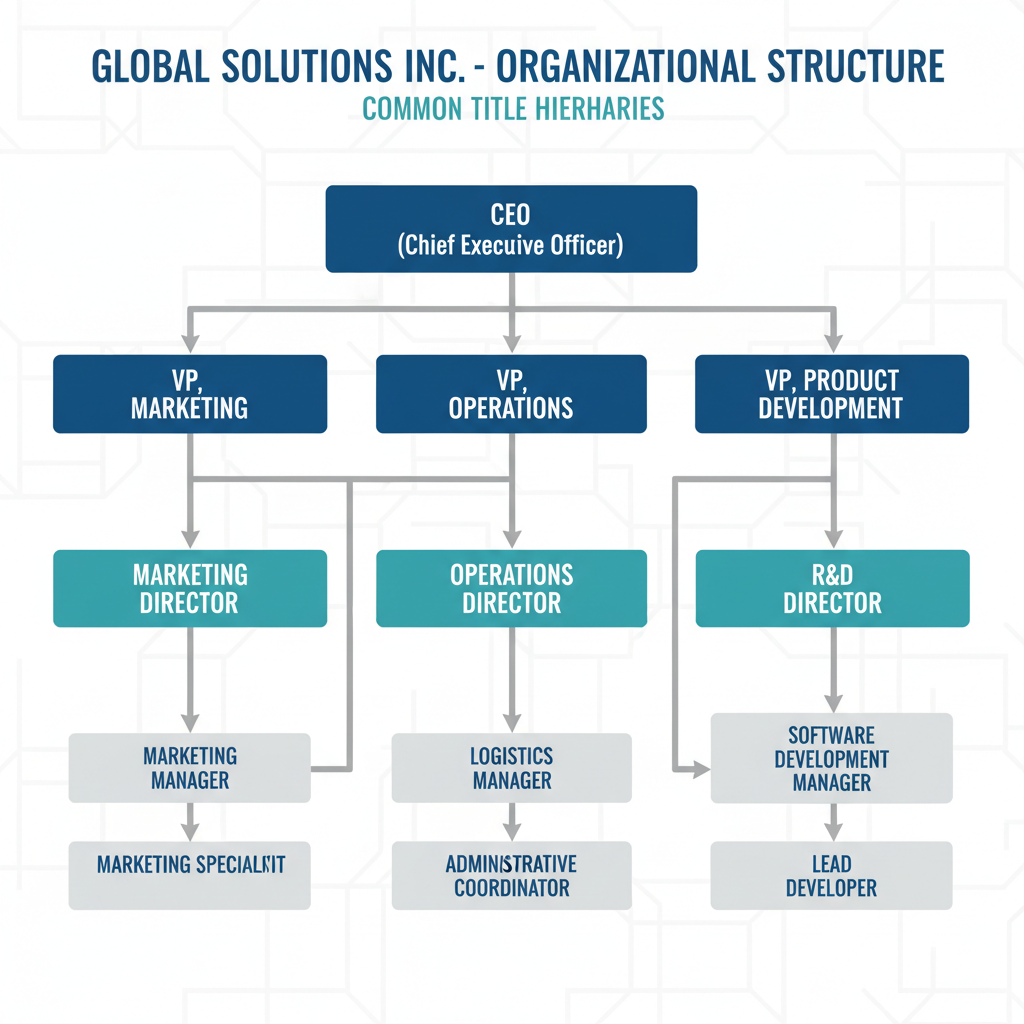
Every organization operates with an internal framework that defines how employees progress through their careers. This framework—often visualized through organizational charts—uses job titles to establish clear hierarchies, reporting relationships, and levels of decision-making authority. Understanding these structures is essential for anyone pursuing career advancement.
Title hierarchies typically follow predictable patterns across industries, though the specific nomenclature may vary. The progression often begins with entry-level positions and moves upward through increasingly senior roles, each carrying greater responsibility and scope.
Common Title Progression Patterns
Most organizations structure their title hierarchies in a way that reflects growing expertise and leadership responsibility. A typical progression might look like this:
- Coordinator/Assistant: Entry-level roles focused on supporting team functions and executing defined tasks
- Specialist/Analyst: Individual contributor positions requiring specialized knowledge and independent project work
- Senior Specialist/Senior Analyst: Advanced individual contributors with deeper expertise and mentorship responsibilities
- Manager: First-line leadership roles overseeing teams and operational execution
- Senior Manager: Expanded management scope with strategic input and larger team oversight
- Director: Department-level leadership with budget authority and cross-functional influence
- Senior Director: Multi-department oversight with significant strategic responsibility
- Vice President (VP): Executive-level leadership shaping organizational strategy and major initiatives
- Senior VP/Executive VP: Top-tier leadership with enterprise-wide impact
This ladder represents a general framework, but the number of steps and specific titles vary by organization size, industry, and culture.
How Organizational Charts Define Authority
Organizational charts do more than display names and titles—they communicate power structures and decision-making flows. Titles on these charts signal who reports to whom, which roles have budget authority, and who participates in strategic planning.
A career framework serves as your organization's blueprint for talent development, outlining how employees grow, progress, and contribute. When you understand where your current title sits within this framework, you can better navigate the path to promotion.
Reporting relationships embedded in title hierarchies determine your access to senior leadership, your involvement in high-visibility projects, and your ability to influence organizational decisions. A specialist typically reports to a manager, limiting their exposure to executive-level conversations. A director, however, often has direct access to VPs and participates in strategic planning sessions.
Vertical vs. Lateral Movement
Career mobility encompasses more than just upward progression. Career mobility is the strategic and methodical progression of employees, encompassing upward, lateral, or cross-functional transitions within their job roles.
Lateral moves—such as transitioning from Marketing Specialist to Sales Specialist—can position you for future upward movement by broadening your skill set and organizational knowledge. Cross-functional transitions help you understand different departments, making you a stronger candidate for management roles that require enterprise-wide perspective.
Vertical movement remains the most direct path to senior titles, but smart professionals recognize that strategic lateral moves can accelerate long-term career advancement by building diverse experience.
Industry and Company Size Variables
Title hierarchies are not uniform across all contexts. A manager at a startup with 50 employees may hold responsibilities equivalent to a director at a Fortune 500 company. Similarly, tech companies often use titles like "engineer" across multiple levels (Software Engineer I, II, III, Staff Engineer, Principal Engineer), while traditional corporations prefer clearer managerial distinctions.
Understanding your organization's specific hierarchy—and how it compares to industry standards—helps you set realistic expectations for promotion timelines and required qualifications. It also prepares you to translate your title appropriately when exploring external opportunities.
Sources
How Titles Directly Influence Promotion Decisions
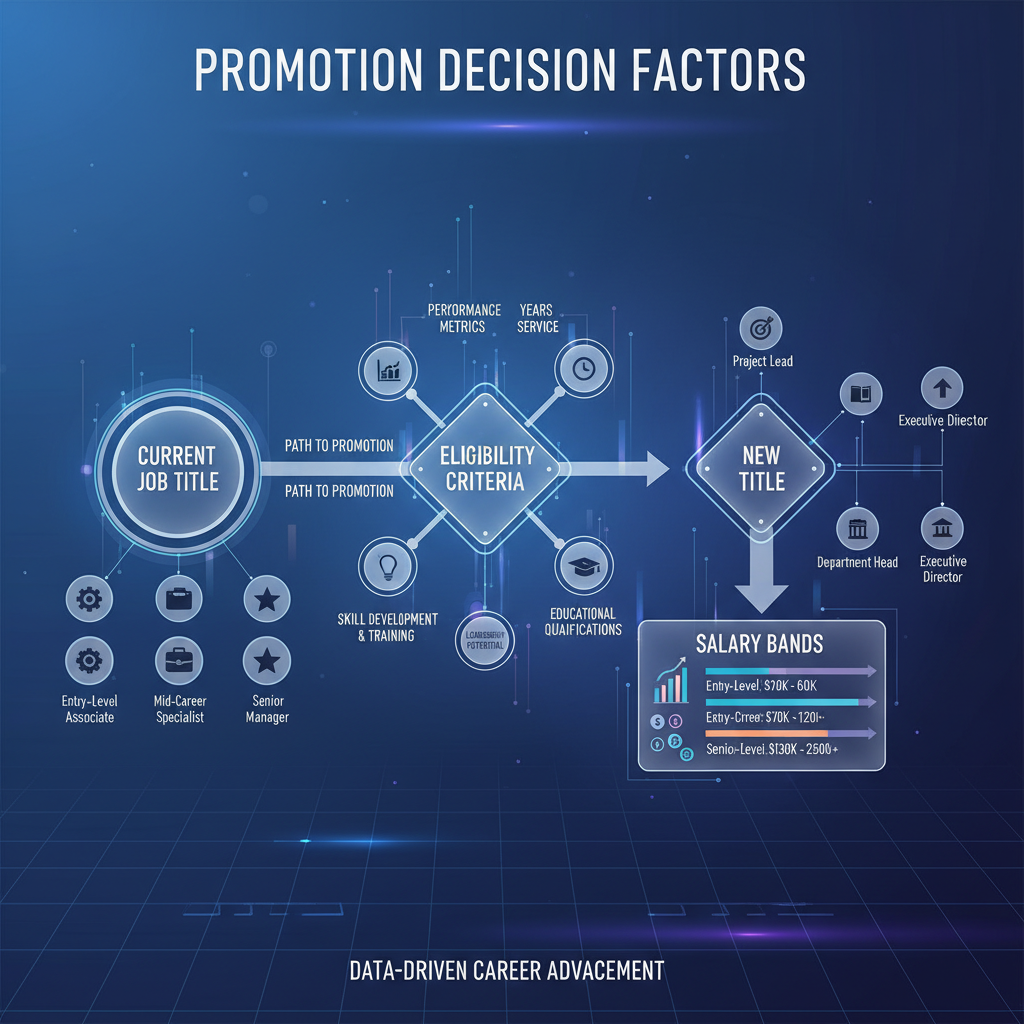
Job titles do more than describe your role—they serve as gatekeepers in the promotion process. Organizations use titles to establish eligibility criteria, define salary bands, and structure succession planning. Understanding these mechanisms is essential for anyone pursuing career advancement.
Eligibility Criteria and Requisition Requirements
Most organizations tie promotion eligibility directly to current job titles. When a senior position opens, requisition requirements often specify minimum title levels candidates must hold. For example, a Director role may require applicants to currently serve as a Manager or Senior Manager. This creates a formal pathway where your title determines which opportunities you can even apply for.
From a recruiting perspective, titles act as the first filter in candidate evaluation. Applicant tracking systems and recruiters use title keywords to screen resumes, meaning your current designation directly impacts whether you're considered for advancement opportunities. Without the right title on your resume, you may be overlooked regardless of your actual capabilities.
Salary Bands and Compensation Structure
Titles are intrinsically linked to compensation frameworks. Organizations assign salary ranges to specific title levels, creating clear boundaries for what each role can earn. When you're promoted to a new title, you typically move into a higher salary band with greater earning potential.
This structure means that career advancement often requires a title change to access increased compensation. Lateral moves within the same title level rarely result in significant salary increases, even when responsibilities expand. Understanding your title's associated salary band helps you set realistic expectations and plan strategic moves.
Succession Planning and Organizational Readiness
Succession planning relies heavily on title hierarchy to identify potential leaders. Organizations map out replacement candidates for key positions based on current titles and progression pathways. If you hold a Manager title, you're positioned as a potential successor for Director roles. Without that title, you're invisible in succession conversations.
Research shows that organizations with structured development programs report a 24% improvement in retention rates compared to companies lacking such frameworks. These programs typically use titles as milestones to track employee progression and identify high-potential talent for advancement.
The Title Gap Challenge
A significant challenge emerges when employee capabilities outpace their titles. Studies indicate that 87% of executives report skill gaps or anticipate them in their workforce, yet only 43% of employees feel their organizations encourage them to seek growth opportunities internally. This disconnect often stems from rigid title structures that don't reflect actual skill development.
When your title doesn't match your competencies, you face barriers in both internal promotions and external opportunities. Recruiters and hiring managers rely on titles as shorthand for experience level, potentially screening out qualified candidates whose titles underrepresent their abilities.
Strategic Implications for Career Advancement
Recognizing how titles influence promotion decisions empowers you to navigate your career more strategically. Pay attention to title requirements in job postings for roles you aspire to reach. Identify any title gaps between your current position and your target role, then work to close those gaps through strategic moves or negotiations.
Consider how your title positions you in succession planning conversations. If you're consistently performing at a higher level than your title suggests, document your achievements and advocate for a title adjustment that accurately reflects your contributions and readiness for advancement.
Sources
Strategic Title Changes as Career Advancement Tools
Not every step forward in your career requires a dramatic leap in responsibilities. Sometimes, a strategic title change can serve as a powerful catalyst for career advancement, positioning you for future opportunities without the immediate burden of significantly expanded duties. Understanding when and how to pursue these changes is essential for professionals navigating their career trajectory.
Lateral Moves and Career Trajectory Mapping
Lateral moves—transitions to roles at a similar level but in different departments or functions—offer unique advantages for long-term growth. These moves allow you to broaden your skill set, expand your internal network, and gain cross-functional expertise that can make you a stronger candidate for leadership positions later. Effective career frameworks recognize multiple trajectories extending beyond vertical advancement, including lateral moves and specialized expert tracks.
When considering a lateral move, evaluate whether the new title better positions you within the organizational hierarchy or industry standards. A shift from "Marketing Coordinator" to "Business Development Associate," for example, might open doors to client-facing opportunities that weren't previously accessible, even if your day-to-day responsibilities remain comparable.
Title Upgrades Without Major Responsibility Changes
Some organizations offer title adjustments that reflect your growing expertise and tenure without fundamentally altering your role. These upgrades—such as moving from "Analyst" to "Senior Analyst" or "Associate" to "Specialist"—carry significant weight in how you're perceived both internally and externally.
These incremental title changes can:
- Signal progression and competence to colleagues and leadership
- Improve your positioning when applying for roles at other organizations
- Increase your credibility when representing your department or company
- Potentially unlock higher salary bands within your current organization
The key is ensuring that the title accurately represents your contributions and aligns with market standards for your experience level.
When to Pursue a Title Change Versus Waiting for Traditional Promotion
Timing matters when seeking title adjustments. Pursue a title change when:
- Your current title significantly undersells your actual responsibilities and expertise
- You've taken on additional duties that align with a higher-level role but haven't received formal recognition
- Your title creates barriers when networking or applying for external opportunities
- Industry standards have evolved, making your current title outdated or unclear
Conversely, waiting for a traditional promotion may be wiser when:
- You're relatively new to your current role and haven't yet demonstrated sustained performance
- Your organization follows strict promotion cycles with defined criteria
- A premature title change might create unrealistic expectations about your capabilities
- You're building toward a specific leadership position that requires demonstrated results over time
Negotiating Title Improvements
When approaching your manager about a title change, come prepared with evidence. Document how your responsibilities have expanded, research comparable titles in your industry, and articulate how the change benefits both you and the organization. Frame the conversation around career advancement and your commitment to continued growth.
Embrace lifelong learning by enrolling in courses that align with your career goals, demonstrating your commitment to growth and adaptability. This proactive approach strengthens your case for title advancement by showing you're investing in the skills that justify the new designation.
Remember that strategic title changes aren't about vanity—they're about ensuring your professional identity accurately reflects your value and positions you effectively for the next stage of your career journey.
Sources
Navigating Title Inflation and Deflation Risks
Job titles can be a double-edged sword in career advancement. While an impressive title might seem like a career win, it can backfire if it doesn't align with your actual responsibilities or market standards. Understanding the risks of title inflation and deflation is essential for maintaining credibility and positioning yourself for genuine promotion opportunities.
The Problem with Inflated Titles
Title inflation occurs when your job title suggests a higher level of authority or expertise than your actual responsibilities demonstrate. This might happen at startups or smaller organizations that use senior-level titles to attract talent without corresponding pay or scope increases.
The risk? You may appear overqualified for roles that match your true experience level, yet underqualified for positions that align with your inflated title. Recruiters and hiring managers can spot these discrepancies quickly, especially when your resume's accomplishments don't support the seniority your title implies.
When evaluating whether your title is inflated, ask yourself: Does my decision-making authority match this title? Do I manage the budget, team size, or strategic initiatives typical for this level? If the answer is no, you may face challenges in your next career move.
The Hidden Cost of Deflated Titles
Conversely, title deflation means your responsibilities far exceed what your job title suggests. This often happens in traditional corporate environments with rigid hierarchies or organizations that delay title changes despite expanded roles.
Deflated titles can undervalue your contributions both internally and externally. Within your organization, you might be overlooked for high-visibility projects or promotions because your title doesn't reflect your capabilities. In the job market, recruiters may screen you out of opportunities you're fully qualified for because your title doesn't match their search criteria.
Recognize deflation when you're consistently performing work typical of the next level up, training others, leading cross-functional initiatives, or making strategic decisions without the corresponding title recognition.
Assessing Market Standards for Your Role
To determine whether your title accurately reflects your position, research market standards within your industry and geography. Review job postings for similar responsibilities and note the titles used. Professional networks and industry associations can provide benchmarking data on typical title progressions.
Pay attention to the responsibilities listed in job descriptions at various levels. If your day-to-day work aligns more closely with a different title, you have evidence for a potential adjustment. Long-term goals that involve growth and increased responsibility require titles that accurately position you for advancement opportunities.
Consider the organizational context as well. A "Director" at a 50-person startup carries different weight than the same title at a Fortune 500 company. Understanding these nuances helps you communicate your experience effectively.
Making Strategic Title Decisions
When faced with title inflation or deflation, take a strategic approach. If offered an inflated title with limited responsibilities, weigh the short-term prestige against long-term career advancement implications. Sometimes accepting a more accurate title with clear growth potential serves you better than an impressive title that creates future obstacles.
For deflated titles, document your expanded responsibilities and prepare a case for title adjustment during performance reviews. Focus on how your contributions align with higher-level roles and how a title change would benefit both you and the organization.
Remember that career advancement depends on the substance behind your title. High employee turnover and organizational instability can disrupt your growth trajectory, so ensure your title accurately represents your value and positions you for continued progression.
Sources
Leveraging Your Title on Resumes and in Interviews
Your job title is one of the first pieces of information recruiters and hiring managers see on your resume. It serves as a quick signal of your level of expertise, scope of responsibility, and career progression. Understanding how to present your title effectively in job search materials—and how to discuss it confidently in interviews—can significantly impact your career advancement prospects.
As a recruiter, I've reviewed thousands of resumes and noticed that candidates who strategically present their titles tend to pass initial screenings more effectively. Your title isn't just a label; it's a powerful keyword that can help you get noticed or cause you to be overlooked.
Optimizing Titles for Applicant Tracking Systems (ATS)
Many organizations use ATS software to filter resumes before they reach human eyes. These systems scan for specific keywords, including job titles that match the position description. If your title differs significantly from industry standards, you risk being filtered out.
To improve your chances, consider these strategies:
- Use standard industry titles when possible, even if your official title was unique to your company
- Include both your official title and a clarifying descriptor in parentheses if needed
- Mirror the language from the job posting when describing your responsibilities
- Customize your resume for each application to align with the target role's title and requirements
Customization is key to effectively presenting your qualifications and ensuring your resume resonates with both ATS filters and human reviewers.
Handling Title Discrepancies and Clarifications
Sometimes your official title doesn't accurately reflect the work you performed or the level at which you operated. Perhaps you held a "Coordinator" title but managed projects and led teams. In these cases, transparency combined with strategic positioning is essential.
Consider these approaches:
- List your official title as it appears in company records, then add a brief descriptor that clarifies your actual role
- Use your experience bullet points to demonstrate responsibilities that align with higher-level positions
- In your cover letter or summary section, explain any title discrepancies proactively
- Be prepared to discuss the gap between your title and responsibilities during interviews
Never fabricate or significantly alter your official title, as this can be grounds for dismissal if discovered during background checks. Honesty paired with clear communication about your actual contributions is the professional approach.
Discussing Title Progression in Interviews
Interviews provide an opportunity to tell the story behind your titles and demonstrate your career advancement trajectory. Hiring managers want to see growth, increased responsibility, and strategic career moves.
When discussing your title history:
- Frame your progression as a narrative of increasing impact and expertise
- Explain the context behind each title change, including expanded responsibilities or organizational restructuring
- Highlight instances where you earned promotions or took on stretch assignments
- Address any lateral moves or title changes by focusing on the skills gained and value delivered
- Connect your title progression to the role you're interviewing for, showing a logical next step
Building a strong personal brand through your professional narrative helps interviewers see you as a candidate with clear direction and proven growth potential. Your online presence should reflect the same progression and values you discuss in person.
Presenting Titles on Your Resume
The format and placement of your job title on your resume matters. Follow these best practices:
- Place your title prominently below the company name and dates of employment
- Use consistent formatting for all titles throughout your resume
- If you held multiple titles at the same organization, list them separately with corresponding date ranges
- Consider bolding titles to make them stand out during quick scans
- Ensure your LinkedIn profile matches your resume to avoid confusion during reference checks
Your resume is a marketing document designed to showcase your qualifications and open doors to interviews. Strategic presentation of your titles, combined with compelling descriptions of your achievements, positions you as a strong candidate for career advancement opportunities.
Sources
How to Negotiate a Title Change or Promotion
Negotiating a title change or promotion requires preparation, timing, and confidence. Many professionals hesitate to initiate these conversations, but advocating for yourself is essential for career advancement. The key is approaching the discussion strategically with a clear business case that demonstrates your value to the organization.
Successful negotiations begin long before you schedule a meeting with your manager. They require documenting your achievements, understanding market standards, and positioning your request as mutually beneficial.
Building Your Business Case
Your business case should clearly articulate why a title change or promotion makes sense for both you and the organization. Start by documenting specific accomplishments that exceed your current role's expectations. Focus on quantifiable results whenever possible—projects completed, revenue generated, processes improved, or teams led.
Next, gather evidence that your responsibilities have expanded beyond your current title. If you're performing duties typically associated with a higher-level position, compile examples that demonstrate this growth. This documentation becomes the foundation of your negotiation.
Research comparable titles and compensation in your industry and geographic area. Understanding market standards strengthens your position and helps you articulate what's fair and competitive.
Timing Your Conversation Strategically
Timing can significantly impact the outcome of your negotiation. The best moments to discuss title changes or promotions include:
- After completing a major project successfully
- During performance review cycles when promotions are typically considered
- When your responsibilities have clearly expanded
- After receiving positive feedback from leadership or clients
- When the organization is performing well financially
Avoid initiating these conversations during budget freezes, organizational restructuring, or periods of company-wide stress. Schedule a dedicated meeting rather than bringing it up casually, signaling that this is an important professional discussion.
Presenting Your Case With Confidence
When you meet with your manager, present your case clearly and professionally. Begin by expressing your commitment to the organization and your desire to continue growing within it. Then outline the specific ways you've contributed value beyond your current role.
Use a framework like this:
"Over the past [timeframe], I've taken on responsibilities that extend beyond my current title as [current title]. Specifically, I've [achievement 1], [achievement 2], and [achievement 3]. Based on my research of industry standards and the scope of my current work, I believe a title of [desired title] accurately reflects my contributions and positions me to continue delivering results for the team."
As one senior recruiter notes, celebrating your accomplishments is essential. Self-promotion demonstrates confidence and helps decision-makers recognize your value.
Handling Objections and Roadblocks
Be prepared for potential objections and have responses ready. Common pushback includes budget constraints, organizational policies, or timing concerns.
If your manager cites budget limitations, propose a title change without immediate compensation adjustment, or ask what specific milestones would justify the promotion. If organizational hierarchy is the concern, discuss alternative titles that reflect your growth while fitting within existing structures.
When timing is the issue, ask for a specific timeline and concrete criteria for reconsideration. Document these commitments in a follow-up email to ensure accountability.
Creating a Development Plan
If your request isn't immediately approved, work with your manager to create a clear development plan. Identify specific skills, projects, or achievements that would support a future promotion. Set measurable goals with defined timelines, and schedule regular check-ins to assess progress.
This approach transforms a "no" into a roadmap for future success and demonstrates your commitment to growth. It also creates documentation that supports your case when you revisit the conversation.
Leveraging Mentorship and Advocacy
Mentorship plays a crucial role in professional growth by helping you set career goals, develop necessary skills, and advocate for promotions. A mentor who understands organizational dynamics can provide valuable guidance on timing, approach, and positioning your request effectively.
Seek advocates within leadership who can speak to your contributions during promotion discussions. Building these relationships before you need them strengthens your position when opportunities arise.
Following Up Professionally
After your negotiation conversation, send a professional follow-up email summarizing the discussion, any commitments made, and next steps. This creates a written record and demonstrates your professionalism.
If your request is approved, express gratitude and confirm your understanding of the new title, effective date, and any associated changes. If it's declined, maintain a positive relationship while continuing to document your achievements and reassess your options.
Negotiating successfully requires persistence, preparation, and confidence in your value. By approaching these conversations strategically, you position yourself for the career advancement you've earned.
Sources
Industry Variations in Title Standards and Expectations
Job titles carry different weight depending on the industry you work in. A "Manager" in tech might oversee a small team of engineers, while the same title in finance could mean responsibility for an entire department's P&L. Understanding these variations is essential for career advancement, especially if you're considering a sector change or want to benchmark your progression against industry standards.
Tech Industry: Flat Hierarchies and Specialized Titles
Technology companies often favor flatter organizational structures with titles that emphasize technical expertise over management. You'll encounter roles like "Senior Software Engineer," "Principal Engineer," or "Staff Engineer" that denote increasing levels of technical mastery without necessarily requiring people management. Individual contributor (IC) tracks can extend to very senior levels, with compensation and influence rivaling traditional executive roles.
Title progression in tech tends to be merit-based and skill-focused. A "Product Manager" at a startup might have broader responsibilities than a "Senior Product Manager" at a large corporation. When transitioning from tech to other sectors, be prepared to translate your specialized title into language that emphasizes leadership scope and business impact.
Finance and Professional Services: Structured Progression Paths
Financial services, consulting, and accounting firms maintain highly structured title hierarchies. Career advancement follows predictable paths: Analyst → Associate → Vice President → Director → Managing Director. These titles signal not just seniority but also client-facing authority and revenue responsibility.
In these industries, titles directly correlate with compensation bands and partnership tracks. A "Vice President" title at an investment bank carries significant weight and typically requires 6-8 years of experience. When moving from finance to other sectors, your title may need context—what you accomplished as a VP matters more than the title itself.
Healthcare: Clinical vs. Administrative Title Tracks
Healthcare organizations maintain dual career ladders: clinical and administrative. Clinical titles (Registered Nurse, Nurse Practitioner, Physician) are regulated by licensing bodies and follow standardized progressions. Administrative titles (Director of Nursing, Chief Medical Officer) blend clinical expertise with management responsibility.
Title standards in healthcare emphasize credentials and certifications. Career advancement often requires additional education or specialized training. When translating healthcare titles to other industries, focus on team size, budget responsibility, and operational scope rather than clinical credentials.
Nonprofit Sector: Mission-Driven Title Structures
Nonprofit organizations often use titles that reflect both functional role and organizational size. A "Development Director" at a small nonprofit might be a one-person fundraising team, while the same title at a large institution could oversee dozens of staff members and multimillion-dollar campaigns.
Title inflation is less common in nonprofits due to budget constraints and donor perception concerns. Career advancement may come through increased program scope or cross-functional leadership rather than title changes. When moving from nonprofit to corporate sectors, emphasize metrics like funds raised, programs launched, or stakeholder relationships managed.
Translating Titles Across Sectors
When changing industries, focus on translating your responsibilities rather than expecting title equivalency. A "Program Manager" in tech might align with a "Project Director" in construction or a "Product Owner" in manufacturing. Research industry-specific career frameworks to understand how your experience maps to new sector norms.
Organizations that facilitate internal career mobility for their top performers enjoy higher retention rates, reduced hiring costs, and improved cross-functional collaboration. Some companies have implemented AI-powered career mapping tools to help employees navigate these transitions more effectively, resulting in measurable improvements in retention among high-potential talent.
Understanding Context-Specific Expectations
Before pursuing career advancement in a new industry, research typical title progressions and tenure expectations. Some sectors promote quickly based on performance, while others follow time-based advancement models. LinkedIn research and informational interviews can reveal these unwritten norms.
Your title's value depends heavily on industry context. A "Director" title earned after three years in a fast-growing startup tells a different story than the same title earned after ten years in a Fortune 500 company. Both paths are valid, but understanding how hiring managers interpret these signals helps you position your experience strategically.
Sources
Conclusion
Throughout this guide, we've explored how job titles serve as more than mere labels—they function as strategic instruments for career advancement. From understanding organizational hierarchies to navigating title inflation risks, the evidence is clear: professionals who approach titles with intentionality position themselves for faster upward mobility and more meaningful promotions.
The relationship between titles and career advancement operates on multiple levels. Titles shape how colleagues, managers, and external recruiters perceive your capabilities and readiness for increased responsibility. They influence compensation benchmarks, promotion eligibility, and even your confidence during negotiations. When you understand how titles function within your industry's specific context, you gain a powerful advantage in steering your professional trajectory.
Taking Strategic Action
Your next step is to audit your current title against industry standards and organizational structure. Ask yourself: Does my title accurately reflect my responsibilities and expertise? Does it position me effectively for the next role I'm pursuing? If gaps exist, develop a clear case for a title adjustment based on expanded duties, market alignment, or strategic repositioning.
In my own career journey, I learned that transitioning from HR Coordinator to HR Specialist wasn't just about expanded responsibilities—it was about how that title change signaled readiness for greater challenges and opened doors to conversations about career growth. The perception linked to your job title can profoundly influence your advancement opportunities.
Remember that career advancement isn't passive. It requires understanding the systems that govern progression, including the often-overlooked role of titles. By applying the strategies outlined in this guide—from strategic title negotiations to leveraging your position on resumes—you're equipping yourself with tools that accelerate professional growth while reducing unnecessary friction.
Structured approaches to career development yield measurable results. Organizations that implement clear frameworks see meaningful improvements in retention and advancement pathways, demonstrating that intentional planning around roles and titles benefits both individuals and employers.
Take ownership of your career narrative. Whether you're preparing for your next promotion conversation or evaluating a job offer, let your understanding of title dynamics inform your decisions. Your career advancement depends not only on the work you do but on how strategically you position that work within your organization's landscape. Start today by assessing where you stand and mapping where strategic title awareness can take you next.
Sources

Written by
Emily Johnson
Published March 2, 2026 · 30 min read
Emily Johnson is a seasoned career strategist with over a decade of experience in recruitment and talent acquisition. With a background in human resources, she excels at helping professionals refine their job search strategies, from crafting compelling resumes to mastering interview techniques. As an expert in Applicant Tracking Systems (ATS), Emily is dedicated to guiding individuals toward their dream careers.
Want this kind of read on your résumé?
We'll tell you what's actually working, what's holding you back, and what to fix — in plain English.
Get My Job Match ScoreYou Might Also Like
More articles to help you advance your career

Job Role Clarity: 9 Essential Steps for Best Career Success
Master job role clarity with 9 essential steps. Align responsibilities, enhance career progression, and achieve a successful professional future.

Salary Negotiation: 9 Essential Strategies for Best Results
Master salary negotiation with 9 essential strategies. Learn proven techniques to maximize your earning potential and achieve the best results.