
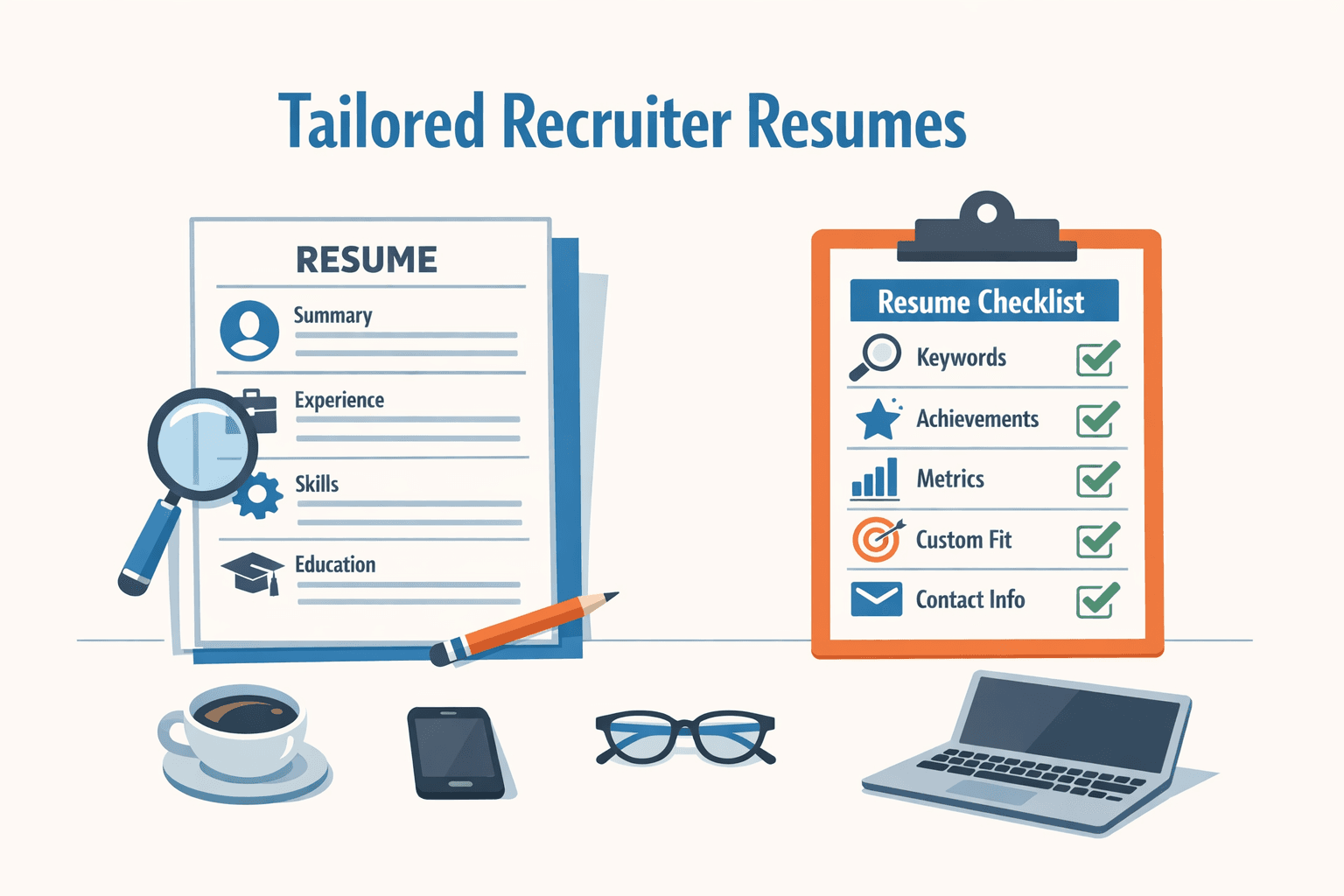
Recruiter Resume Template: The Ultimate Guide to Best Results
Learn why a generic recruiter resume template won't work and discover the best strategies to create a standout resume that gets results.
 John Cronin
Introduction
A generic recruiter resume template is a trap. You download it, fill in the blanks, and wonder why you're not getting callbacks. The reason is simple: recruiters reviewing your resume are professionals who screen resumes for a living. They know every trick, every padding move, every hollow bullet point. When I was at Meta sourcing machine learning engineers, I saw hundreds of recruiter resumes cross my desk. The ones that worked weren't the prettiest — they were the ones that showed concrete impact in language I could verify.
Here's the paradox: recruiter resumes are judged by people who know exactly what a strong resume looks like. That means the bar for metrics, formatting, and specificity is higher than for any other role. A software engineer can get away with "improved system performance"; a recruiter writing "improved hiring process" will get tossed. You need numbers, context, and outcomes that demonstrate you understand what hiring managers care about. A role targeted resume isn't optional for recruiters — it's the baseline.
The data backs this up: a significant majority of resumes are rejected before a human ever reads them. For recruiters, that rejection happens faster because the reviewer is trained to spot gaps. A recruiter resume must show both recruiting expertise and quantifiable business impact. If your template doesn't force you to answer "how many," "how fast," and "what changed," it's working against you.
This guide walks through why generic templates fail and what actually works. You'll see how to structure your resume for the role you want, how to use honest examples that demonstrate impact, and how to navigate the systems that scan your resume before a human sees it. No fluff, no template worship — just the moves that get you past the first screen.
The Problem with Generic Resumes
A generic recruiter resume template creates a paradox: you're applying to people who screen resumes for a living. The bar for metrics, formatting, and specificity is higher for recruiting roles than for almost any other position. When you use a template that lists vague responsibilities instead of concrete outcomes, you're signaling that you don't understand the job you're applying for.
Most resumes never reach a human reviewer. The rejection happens in seconds, often before anyone reads past your current title and previous companies. Recruiters spend an average of 7.4 seconds screening a resume, focusing on current title, previous companies, and education. If your template doesn't surface those details immediately, you've lost the round.
Why Templates Fail for Recruiting Roles
Generic templates bury the information that matters. They use broad phrases like "responsible for recruitment" or "managed hiring process" without showing scale, speed, or business impact. A hiring manager reading your resume wants to know how many hires you closed per quarter, what your time-to-fill was, and whether you built systems or just followed them.
Templates also ignore role-specific nuances. A technical recruiter needs to show they understand engineering roles and can speak the language of the teams they hire for. An agency recruiter needs to demonstrate client management and business development. A corporate recruiter needs to show they can navigate internal stakeholders and build long-term pipelines. One template can't address all three.
When you rely on a template, you're competing against candidates who tailored their resumes to the specific role. You're bringing a generic tool to a precision task. For guidance on creating a role targeted resume that addresses specific hiring needs, focus on the outcomes that match the job description.
A template tells the reviewer you didn't care enough to customize. In recruiting, that's a disqualifying signal.
The Real Cost of Generic Language
Vague accomplishments don't survive the first screen. Phrases like "improved hiring process" or "supported talent acquisition" tell the reviewer nothing about what you actually did. They don't know if you hired five people or five hundred, if you reduced time-to-fill by days or weeks, or if you worked alone or led a team.
Generic resumes also fail to pass applicant tracking systems. Without specific keywords tied to the role—like "technical recruiting," "candidate pipeline," or "stakeholder management"—your resume gets filtered out before a human ever sees it. Templates often include irrelevant skills or outdated terminology that triggers the wrong filters.
The cost isn't just a missed interview. It's the signal you send about how you approach your work. If you can't tailor your own resume, how will you tailor a candidate's pitch to a hiring manager? Recruiting is a customization job, and your resume is the first proof point.
Understanding Role-Specific Needs
A recruiter resume must demonstrate both recruiting expertise and quantifiable business impact. The problem is that recruiting isn't one job — it's dozens of specialized roles, each with different expectations. A technical recruiter sourcing engineers needs a completely different skill set than a campus recruiter building entry-level pipelines. Your resume needs to show you understand the specific role you're applying for.
Generic templates fail because they treat all recruiting roles the same. They list "talent acquisition" and "stakeholder management" without showing how you applied those skills in context. When I scan resumes at volume, I'm looking for evidence that you've done the specific work the role requires. If you're applying for a technical recruiting position, I want to see sourcing strategies for hard-to-fill roles, not just a bullet about "managing candidate pipelines."
What Different Recruiting Roles Actually Need
Technical recruiters need to demonstrate sourcing expertise for specialized talent. Your resume should highlight how you identify passive candidates, navigate technical communities, and match the right talent to the right roles. If you've built Boolean search strings or sourced from GitHub, say so.
Executive recruiters operate in a different world entirely. The focus shifts to confidentiality, senior stakeholder management, and long sales cycles. Your resume should show experience with C-suite searches, board-level discretion, and relationship-building at the executive level.
High-volume recruiters need to prove operational efficiency. Hiring managers want to see metrics: how many requisitions you managed simultaneously, your time-to-fill averages, and how you maintained quality at scale. If you've managed 50+ open roles at once or built screening processes that reduced interview-to-offer ratios, those numbers matter.
Matching Your Experience to the Role
Before you write a single bullet, read the job description and identify the three most important requirements. Then audit your resume: does every major bullet point connect to at least one of those three requirements? If not, you're wasting space.
For a role targeted resume, think about what the hiring manager actually cares about. A startup hiring its first recruiter wants to see scrappy, zero-to-one building. A Fortune 500 company wants process discipline and compliance knowledge. Your resume should make it obvious within ten seconds that you've done this specific type of work before.
The best recruiter resumes don't try to be everything to everyone. They pick a lane and demonstrate depth. If you've worked across multiple recruiting specialties, that's fine — but organize your resume so the most relevant experience comes first, and tailor your bullet points to emphasize the skills that match the role.
Effective Resume Structure for Recruiters
A recruiter resume isn't a novel. It's a scan-friendly document that needs to surface your value in the first ten seconds. Most hiring managers skim rather than read, so your structure has to do the heavy lifting. The goal is to make it impossible for them to miss your strongest evidence.
Start with a header that includes your full name, email address, phone number, and location. If you have a LinkedIn profile or a portfolio site that shows actual work, add those too. Skip the street address—city and state are enough.
The Professional Summary Block
Right after your header, include a three-to-four-sentence professional summary. This is where you anchor your pitch. A strong summary names the role you're targeting, highlights one or two key metrics (like "placed 50+ technical hires in 18 months" or "reduced time-to-fill by 30%"), and mentions the recruiting specialty you bring. Avoid vague language like "results-oriented professional"—use concrete numbers that prove you've done the work.
Skills Section: Prioritize and Prune
List ten to fifteen prioritized skills. Put the most relevant ones first—if you're applying for a technical recruiting role, lead with "Boolean search," "GitHub sourcing," or "technical screening." If it's agency work, prioritize "client relationship management" and "full-cycle recruiting." Don't pad the list with generic terms like "Microsoft Office" unless the job description explicitly asks for them. For more on how systems parse these sections, see our guide on how ATS reads resumes.
Work Experience: Four to Five Bullets Per Role
Each role should have four to five bullet points. Start each bullet with a strong verb and include a quantified outcome whenever possible. The structure is simple: what you did, the scale at which you did it, and the result. For example, "Managed full-cycle recruiting for 12 engineering roles, reducing average time-to-fill from 45 to 28 days." This format makes it easy for a hiring manager to see both the scope and the impact.
A recruiter resume should surface your strongest evidence in the first ten seconds—structure it so they can't miss it.
Keep job descriptions tight. Two to three sentences of context per role is enough. The bullets carry the weight, not the paragraph above them. If a role is older than ten years or irrelevant to the job you're targeting, compress it into a single line or drop it entirely.
Education and Certifications
List your degree, the institution, and the year. If you have recruiting certifications—AIRS, SHRM, LinkedIn Recruiter—add those in a separate section. Certifications signal that you've invested in the craft, especially if you're early in your career or pivoting from another function.
| Section | What to Include | What to Skip |
|---|---|---|
| Header | Name, email, phone, location, LinkedIn | Street address, photo |
| Summary | Role target, 1-2 key metrics, specialty | Generic adjectives, mission statements |
| Skills | 10-15 prioritized, role-relevant terms | Filler skills, outdated tools |
| Experience | 4-5 quantified bullets per role | Long paragraphs, duties without outcomes |
| Education | Degree, institution, year, certifications | High school, unrelated coursework |
The structure above works because it respects how hiring managers actually read resumes: top to bottom, looking for proof that you can do the job. Every section should answer the question, "What makes this person worth a phone screen?" If a line doesn't answer that question, cut it.
Using SPOR in Your Resume
Most recruiter resumes list responsibilities. They say "managed candidate pipelines" or "conducted phone screens." That tells me what you did, not what you accomplished. When I'm scanning resumes at volume, I need to see impact in seconds. That's where SPOR comes in: Situation, Problem, Outcome, Result. It's a framework that forces you to tell a complete story in a single bullet point.
What SPOR Actually Means
SPOR isn't complicated. Start with the Situation: what was the context? Then the Problem: what challenge did you face? Follow with the Outcome: what action did you take? End with the Result: what measurable impact did it have? Every bullet should answer these four questions. If you can't fill in all four, the bullet isn't strong enough.
Here's the difference. A weak bullet says: "Recruited software engineers for technical roles." A SPOR bullet says: "Inherited a stalled engineering pipeline with zero offers in six months (Situation/Problem), rebuilt sourcing strategy and candidate experience (Outcome), resulting in 12 hires in Q3 and 40% faster time-to-offer (Result)." The second version shows scale, challenge, and measurable improvement.
Building SPOR Bullets That Work
Start by auditing your current bullets. Pick your three strongest accomplishments from each role. For each one, write down the situation you walked into, the specific problem you solved, the action you took, and the measurable result. Don't generalize. "Improved hiring" is vague. "Reduced time-to-hire by 40%" is concrete.
Quantifying achievements is what separates a forgettable resume from one that gets callbacks. Hiring managers want to see numbers: percentages, timelines, headcount, budget. If you increased diverse hires by 30%, say so. If you managed a pipeline of 200 candidates per quarter, include that. Metrics prove you understand what matters in recruiting: speed, quality, and efficiency.
For roles where you lack hard numbers, focus on scope and complexity. "Launched campus recruiting program across five universities" tells me scale. "Partnered with engineering leadership to redefine IC4 hiring bar" shows strategic influence. Even without percentages, you're painting a picture of impact.
At high volumes, recruiters scan rather than read—your SPOR bullets need to communicate value in under five seconds.
Common SPOR Mistakes to Avoid
The biggest mistake is burying the result. Don't save your win for the end of a long sentence. Lead with impact when you can: "Reduced agency spend by 60% by building internal sourcing playbook for sales roles." I see the number first, then I read the rest.
Another pitfall: using SPOR for every bullet. Not every task deserves the full framework. If you're listing a routine responsibility, a simple action + result works fine: "Conducted 15–20 phone screens per week with 80% pass-through rate." Save SPOR for your standout achievements—the ones that differentiate you from other candidates.
Finally, don't fabricate metrics. If you didn't track a number, don't guess. Honesty matters. A vague but truthful bullet is better than a precise lie. When I'm checking references, inflated claims come out fast. Stick to what you can defend in an interview. For more on aligning your resume to specific role expectations, see our guide on role targeted resumes.
Examples of Tailored Resumes
Seeing what works is faster than guessing. Below are three examples of strong recruiter resume bullets that show exactly how tailoring changes the game. Each one follows the same pattern: specific role, concrete numbers, and an outcome that matters to the hiring manager.
What Makes a Bullet Strong
A tailored bullet doesn't just list what you did—it shows the scope, the challenge, and the result. Compare "Recruited for engineering roles" to "Managed full-cycle recruiting for 35 engineering roles; averaged 26-day time-to-fill with 94% offer-accept rate." The second version tells the reader you can move fast and close candidates. That's what gets you the interview.
The difference is specificity. When you say "35 engineering roles," the reader knows you weren't just filling one or two backfills. When you say "26-day time-to-fill," they know you understand urgency. When you say "94% offer-accept rate," they know you're not burning through candidates or making bad pitches.
Example One: Full-Cycle Technical Recruiter
"Technical Recruiter with 5 years of experience hiring software engineers, filled 120+ technical roles annually with an average time-to-fill of 32 days and 87% offer acceptance rate."
This works because it tells you the recruiter's specialty (technical), the volume (120+ per year), the speed (32 days), and the close rate (87%). If you're hiring for a high-volume technical recruiting role, this person just proved they can do the job. If you're hiring for agency recruiting, this might be less relevant—but the structure is still sound.
Example Two: Client-Facing Agency Recruiter
"Managed client accounts and led junior recruiters, achieving 100% client retention rate while placing top talent across finance and consulting verticals."
This bullet emphasizes relationship management and retention, which matters more in agency or RPO roles than in-house recruiting. The "100% client retention" line is the hook—it says this person doesn't just fill roles, they keep clients coming back. The mention of "led junior recruiters" adds people management, which is useful if the role involves team leadership.
Example Three: High-Volume In-House Recruiter
"Managed full-cycle recruiting for 35 engineering roles; averaged 26-day time-to-fill with 94% offer-accept rate."
This is a clean, high-impact bullet for in-house recruiting. It shows the recruiter can handle a large pipeline, move quickly, and close offers. If the hiring manager is looking for someone to own a high-volume funnel, this line does the work. It's also easy to scan—three numbers, one sentence, zero fluff.
For more on how to structure your entire resume around role-specific needs, see our guide on role targeted resumes.
How to Adapt These Examples
If you're writing your own bullets, start with the template: [Action verb] + [scope/volume] + [metric or outcome]. Then adjust the metric to match what the role cares about. If it's agency recruiting, emphasize client retention or revenue. If it's in-house, emphasize time-to-fill or quality-of-hire. If it's executive search, emphasize seniority of placements or offer acceptance at the director level and above.
Don't invent numbers, but do be specific. "Recruited for multiple teams" becomes "Recruited for 4 product teams across 18 months." "Improved time-to-fill" becomes "Reduced average time-to-fill from 45 to 32 days." The second version in each case is stronger because it's verifiable and concrete.
Navigating Recruiter ATS
Applicant tracking systems scan your resume before any human sees it. The irony is that recruiters—who build and tune these systems—often stumble when their own resumes hit the parser. A recruiter resume template that looks polished in a PDF can turn into garbled text when an ATS tries to read it.
The fix is simpler than most candidates think. Use a clean, single-column layout with standard fonts and no images, tables, or text boxes. ATS parsers expect plain structure: your name at the top, clear section headings like "Work Experience" and "Skills," and bullet points that start on their own lines. When the system can read your resume cleanly, it can match your keywords to the job description—and that's what gets you past the first gate.
Keep Formatting Minimal
Complex graphics and creative layouts break ATS parsing. Stick to standard headings, left-aligned text, and simple bullets. If you're tempted to use a two-column design or embed a photo, remember that the ATS will likely miss half your content or scramble the order.
Keywords matter, but stuffing them in white text or hidden layers will backfire. Modern ATS tools flag keyword spam, and recruiters reviewing flagged resumes will toss them immediately. Instead, weave relevant terms naturally into your bullets—"full-cycle recruiting," "candidate pipeline," "offer negotiation"—so the system and the human reader both see a coherent story.
For more on how ATS systems parse resumes and what triggers failures, see our guide on how ATS reads resumes.
Who Should Choose What
Not every recruiter needs the same resume format. Your career stage, target role, and work history shape which structure will serve you best.
Early-Career Recruiters: Lead with Education and Skills
If you're new to recruiting—less than three years in—a functional or hybrid format helps you highlight transferable skills over thin work history. Put your education near the top, especially if you have relevant coursework or certifications in HR, psychology, or business. List skills like "candidate sourcing," "interview coordination," and "ATS proficiency" before diving into job titles. This lets hiring managers see your capabilities before they notice you've only held one or two roles.
For entry-level agency or in-house coordinator positions, emphasize any internships, volunteer work, or campus recruiting experience. Even if you coordinated a career fair or managed a student organization's hiring committee, that's real recruiting work—frame it as such.
Mid-Career Recruiters: Chronological with SPOR Wins
Once you have three to seven years and a clear progression—coordinator to recruiter to senior recruiter—a reverse-chronological format is your cleanest bet. Hiring managers expect to see where you've been and how you've grown. Within each role, use SPOR to quantify your impact: "Reduced time-to-fill from 45 to 28 days by implementing a structured phone screen rubric" tells a sharper story than "Managed full-cycle recruiting."
This is also the stage where you tailor your resume to the specific role you're chasing. If the job description emphasizes high-volume hiring, reorder your bullet points so volume metrics appear first. If it's about employer branding, lead with your content or event work.
Senior and Leadership Recruiters: Strategic Narrative
At the senior, lead, or director level, your resume is less about tasks and more about outcomes and scope. Hiring managers want to know: How many recruiters did you manage? What was your budget? Which systems did you implement or overhaul? A chronological format still works, but your bullets should read like a strategic narrative—"Built a five-person recruiting team from scratch, scaling from 20 to 120 hires per year" or "Led vendor negotiation that cut agency spend by 30% while maintaining quality of hire."
If you've worked across multiple industries or geographies, consider a brief "Career Highlights" section at the top to anchor your expertise before the chronological detail. This prevents a hiring manager from getting lost in the weeds of your earlier roles.
Specialists and Niche Recruiters: Highlight Your Domain
If you recruit in a specialized field—tech, healthcare, executive search, diversity hiring—make that specialization impossible to miss. Put it in your summary, in a "Core Competencies" section, and in the titles of your roles if accurate ("Technical Recruiter" beats "Recruiter" when the job is technical). Hiring managers in niche recruiting want proof you understand the domain, not just the process. Mention specific tools (LinkedIn Recruiter, GitHub sourcing, Boolean strings for rare skills) and any certifications or training that signal expertise.
Final Tips for Recruiter Resumes
You've structured your resume, chosen role-specific achievements, and written honest SPOR examples. Now lock in the details that separate a scan-worthy document from one that gets filed away. These final tips address the small choices that compound into a standout recruiter resume template.
Lead With Results, Not Responsibilities
Recruiters scan for outcomes, not task lists. Instead of "Managed full-cycle recruitment," write "Hired 40 engineers in 18 months, reducing time-to-fill by 12 days." Every bullet should answer the question: what changed because you were in the role? When I was managing high-volume technical hiring, the resumes that caught my attention showed concrete wins—placements made, pipelines built, offer-acceptance rates improved. Generic duty statements tell me you showed up; results tell me you delivered.
Use Action Verbs That Show Initiative
Start bullets with verbs that position you as the driver: sourced, launched, negotiated, streamlined, partnered. Avoid passive constructions like "was responsible for" or "duties included." Action verbs signal that you initiate and execute, not just participate. In a role targeted resume, this distinction matters—hiring managers want to see agency, especially in recruiting roles where proactive sourcing and relationship-building are core skills.
Keep Formatting Clean and Scannable
Use consistent fonts, clear section headers, and plenty of white space. Recruiters spend seconds per resume at first pass; dense blocks of text get skipped. Stick to standard section names—Experience, Skills, Education—so ATS and human readers find what they need fast. Avoid tables, text boxes, or graphics that confuse parsing software. A clean, boring layout beats a creative one that breaks in the ATS every time.
A resume that's easy to scan is a resume that gets read—formatting is a courtesy to the person deciding your next step.
Tailor Every Time
No single version works for every application. Adjust your summary, reorder bullets, and swap examples to match the job description. If the role emphasizes diversity hiring, lead with your diversity-sourcing wins. If it's a startup, highlight your ability to build from scratch. Tailoring takes ten minutes per application; it's the difference between a polite rejection and a phone screen.
Proofread With Fresh Eyes
Typos and formatting inconsistencies signal carelessness. Read your resume aloud, run it through a spell-checker, and ask a friend to review it. Check that dates align, verb tenses are consistent, and every claim is accurate. In recruiting, attention to detail is part of the job—your resume should prove you have it.
These final adjustments turn a competent draft into a document that gets callbacks. Focus on clarity, results, and role alignment, and your recruiter resume template will do the work it's supposed to: get you in front of the hiring manager.
Conclusion
A generic recruiter resume template won't get you past the first screen. Recruiters evaluate resumes the same way they evaluate candidates—looking for proof of impact, not just a list of tasks. The difference between a resume that lands interviews and one that gets passed over comes down to specificity: role-targeted structure, honest SPOR examples, and quantifiable outcomes that show you understand the business side of recruiting.
Throughout this guide, we've covered why templated language fails, how to structure your resume for the role you want, and what hiring managers actually look for when they scan your application in those critical first seconds. The fundamentals are straightforward: lead with metrics, tailor your experience to the job description, and make sure your resume passes ATS without sacrificing readability.
In my 25 years in talent acquisition, I've seen thousands of recruiter resumes. The ones that stand out aren't the most polished—they're the ones that demonstrate clear value. When I built the recruiting function at Chipper Cash from scratch, I wasn't hired because my resume looked pretty; I was hired because it showed exactly what I'd built, the teams I'd scaled, and the budgets I'd managed. Your resume should do the same.
If you're serious about landing your next recruiting role, treat your resume like you'd treat a candidate's: with scrutiny, honesty, and a focus on what actually matters. For more insights on how ATS systems evaluate resumes and what you can do to optimize yours, check out our guide on how ATS reads resumes. The work you put into tailoring your resume now will pay off when the interview requests start coming in.

Written by
John Cronin
Published August 21, 2026 · 21 min read
John Cronin is a talent-acquisition leader with 25 years in recruiting, most recently as a Principal Technical Recruiter at Meta hiring machine-learning and AI engineers. He has been a founding recruiter at GoPro and Chipper Cash and led talent acquisition at Imgur. He writes about what recruiters actually do with your resume.
Want this kind of read on your résumé?
We'll tell you what's actually working, what's holding you back, and what to fix — in plain English.
Get My Job Match ScoreYou Might Also Like
More articles to help you advance your career
Job Scam History: The Ultimate Guide to Surprising Trends
Discover job scam history and explore the surprising evolution of employment fraud tactics that have targeted workers throughout the decades.

10 Essential Tips for a Financial Analyst Resume Template: The Ultimate Stress-Free Guide
Discover the best financial analyst resume template strategies to create a stress-free, job-winning application that stands out to employers.

Electrical Engineer Resume Template: The Ultimate Simple Guide
Master the electrical engineer resume template with our ultimate guide. Learn simple strategies to create a standout resume that gets results.

Job Offer Pitfalls: Simple Must-Know Tips for Your Success
Avoid job offer pitfalls with these simple must-know tips for securing your ideal position and ensuring a successful career transition.